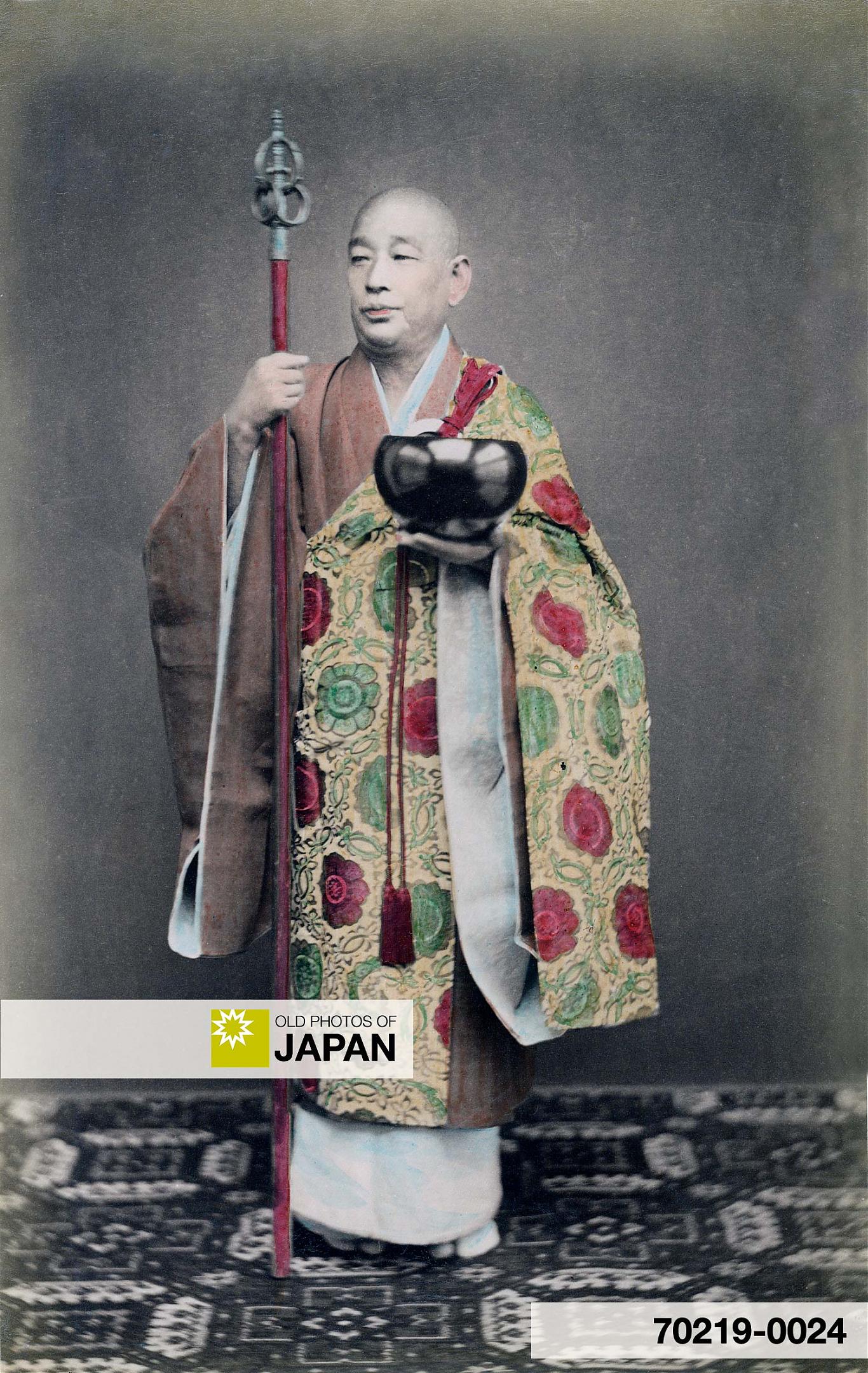
This Buddhist priest holds a begging bowl and a staff. He is wearing a monk’s stole, called kesa (袈裟) made of sumptuous silk brocade. Kesa are draped over one shoulder and under the opposite arm in order to wrap it around the body.
They are believed to resemble a garment made for Buddha by his mother. Of a simple rectangular form, they have barely changed since Buddhism was first introduced in Japan during the sixth century.
Kesa are classified into categories. In the Zen schools, there are three primary types of kesa, those with five, seven or nine strips of cloth. Each type of kesa is supposed to bring a different benefit to its wearer. A kesa with five strips removes greed, one with seven strips anger, and the one with nine strips ignorance.1
The kesa can be seen as a mandala, a symbolic rendering of the cosmos. The four squares in the corner represent the four directions, the column in the center symbolizes the Buddha, and the two squares on the side are his attendants.
The Japanese Zen Buddhist teacher and philosopher Dogen Zenji (道元禅師, 1200-1253) believed that the kesa was more than a mere robe to distinguish a group of people and that it represented Dharma (the virtuous path). He wrote2:
It is clear that the Dharma that is symbolized by the kesa has been transmitted from master to master. To think that it is without value or that it has not been correctly transmitted is evidence of lack of faith. He who is interested in arousing the thought of enlightenment must be instructed in the correct transmission of the ancestors. He is not only a person who has encountered the Dharma, which is hard to encounter, he is in fact a descendent of the Dharma that is correctly transmitted in the form of the Buddha’s robe. He sees it, learns it, and now wears the robe. In other words, he is in reality standing right in front of the Buddha, meeting him, hearing him preach the Dharma, and being illuminated by his light. Wearing the kesa means using what the Buddha used and transmitting the Buddha’s mind to oneself. It means acquiring the essence of the Buddha.
While in China, Dogen saw a Chinese monk pay respect to his kesa by placing it on his head every morning and reciting verses. He was deeply moved.3
At that time I was filled with the deepest emotion and joy that I had ever experienced. Unknowingly, I shed so many tears of gratitude that my collar became wet.
The walking staff represents the authority of the priest as an authentic Buddhist practitioner. Traditionally, Zen masters wandered in the mountains to contemplate. During such journeys, he was expected to bring back a staff taken from a fallen tree. This practice may have its origins in Chinese folk religions.4
The begging bowl shows the priest’s determination to give up earthly possessions. It used to be one of the only possessions that was allowed and was used by priests to go out to beg for alms.
Notes
1 Baroni, Helen Josephine (2002). The Illustrated Encyclopedia of Zen Buddhism. The Rosen Publishing Group, 188-189. ISBN 0823922405.
2 Cook, Francis Harold et al (2002). How to Raise an Ox: Zen Practice as Taught in Zen Master Dogen’s Shobogenzo. Wisdom Publications, 21. ISBN 0861713176.
3 Dumoulin, Heinrich et al (2005). Zen Buddhism, Volume 2: A History. World Wisdom, 94. ISBN 0941532909.
4 Heine, Steven (2004). Opening a Mountain: Koans of the Zen Masters. Oxford University Press US, 144. ISBN 0195174348.
Published
Updated
Reader Supported
Old Photos of Japan aims to be your personal museum for Japan's visual heritage and to bring the experiences of everyday life in old Japan to you.
To enhance our understanding of Japanese culture and society I track down, acquire, archive, and research images of everyday life, and give them context.
I share what I have found for free on this site, without ads or selling your data.
Your support helps me to continue doing so, and ensures that this exceptional visual heritage will not be lost and forgotten.
Thank you,
Kjeld Duits
Reference for Citations
Duits, Kjeld (). 1890s: Buddhist Priest, OLD PHOTOS of JAPAN. Retrieved on June 9, 2026 (GMT) from https://www.oldphotosjapan.com/photos/421/buddhist-priest


Tornadoes28
I believe the staff also has 6 rings at the top. I believe the rings symbolize of the realms such as the Hell reamls, human realm, etc.
#000343 ·