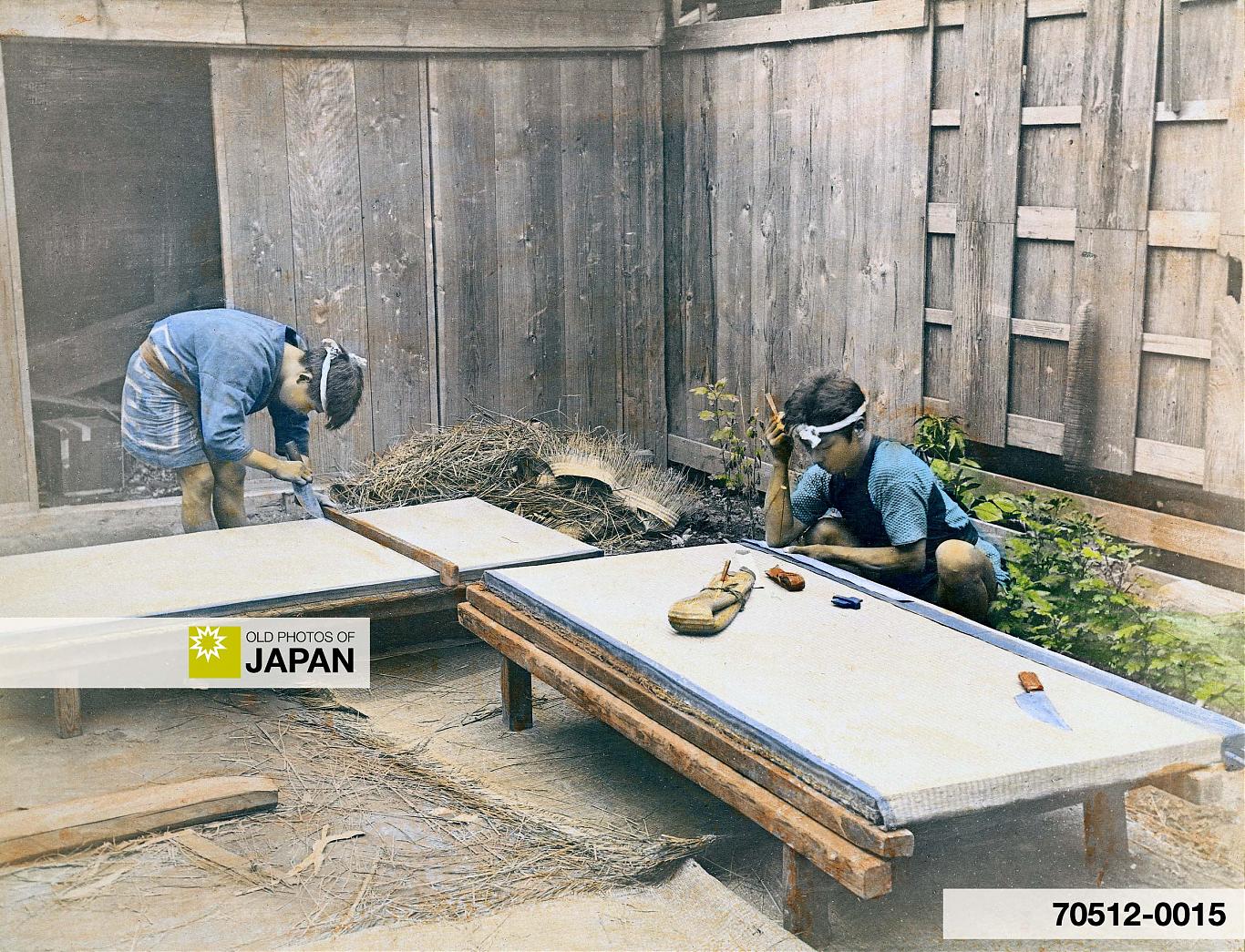
Two craftsmen are making tatami floor mats at an outside work place. Their tools can be seen on top of the tatami.
The origin of tatami goes back to ancient times when people sat on thin mats folded and piled on the floor. Over the years this evolved into the tatami that we know today.
It would take until the 17th century before they were commonly used among all classes to cover the whole floor. Since the end of WWII, with people turning to Western furniture, they have been gradually fading away from Japanese homes. Nowadays, an increasing number of new apartments have none.
Tatami consists of a top layer, called tatami-omote (畳表), a base, called toko (床), and a thin strip of cloth that is sewn to the edges. This thin strip is called heri (縁).
The tatami-omote is traditionally woven from a soft rush called igusa (藺草). But recently, artificial types made of plastic or wood pulp are used as well. Toko is made from straw bound with hemp thread or synthetic fiber. For heri, hemp, cotton or synthetic fiber is used.
Because the measurements of Japanese rooms are usually described by the number of tatami that fit into them—regardless of whether the room contains tatami or not—it is often assumed that all tatami are the same size. This is actually not true. The size of a tatami varies by region. Here are some regions and the sizes of their tatami, going from small to large:
As you can see, tatami in the Kansai region are actually 1.18 times as large as those in the Kanto area.
There is also a type of tatami that is called danchima (団地間). Measuring just 170 × 85 cm, it is the smallest of the “regular” sized mats. They were specifically designed for danchi, low-rent public apartment complexes that were first built during the 1950’s.
Additionally, there are tatami half the size of regular mats, called hanjo (半畳), and three-quarters sized ones called daime-datami (台目畳).
Although in the past these were often used in tea ceremony rooms, these days such irregularly sized tatami are increasingly used to provide an accent to a modern interior. They even come in different colors from light yellow to pink to grey. A combination of for example nine hanjo in two colors looks extremely attractive.
As tatami played a very important role in Japanese life over many centuries, they have naturally entered the Japanese language. Lots of proverbs use tatami in some form.
For example, to practice swimming on tatami (畳の上の水練, tatami no ue no suiren) means lots of talk, but no action. Another one is, even if a room has a thousand tatami, you only need one to sleep on (千畳敷に寝ても一畳, senjojiki ni netemo ichijo). In other words, don’t be greedy.1
Notes
1 Kyoto International Community House Newsletter. April 2003: History of tatami. Retrieved on 2008/7/1.
Published
Updated
Reader Supported
Old Photos of Japan aims to be your personal museum for Japan's visual heritage and to bring the experiences of everyday life in old Japan to you.
To enhance our understanding of Japanese culture and society I track down, acquire, archive, and research images of everyday life, and give them context.
I share what I have found for free on this site, without ads or selling your data.
Your support helps me to continue doing so, and ensures that this exceptional visual heritage will not be lost and forgotten.
Thank you,
Kjeld Duits
Reference for Citations
Duits, Kjeld (). 1890s: Making Tatami, OLD PHOTOS of JAPAN. Retrieved on June 9, 2026 (GMT) from https://www.oldphotosjapan.com/photos/294/making-tatami


There are currently no comments on this article.