
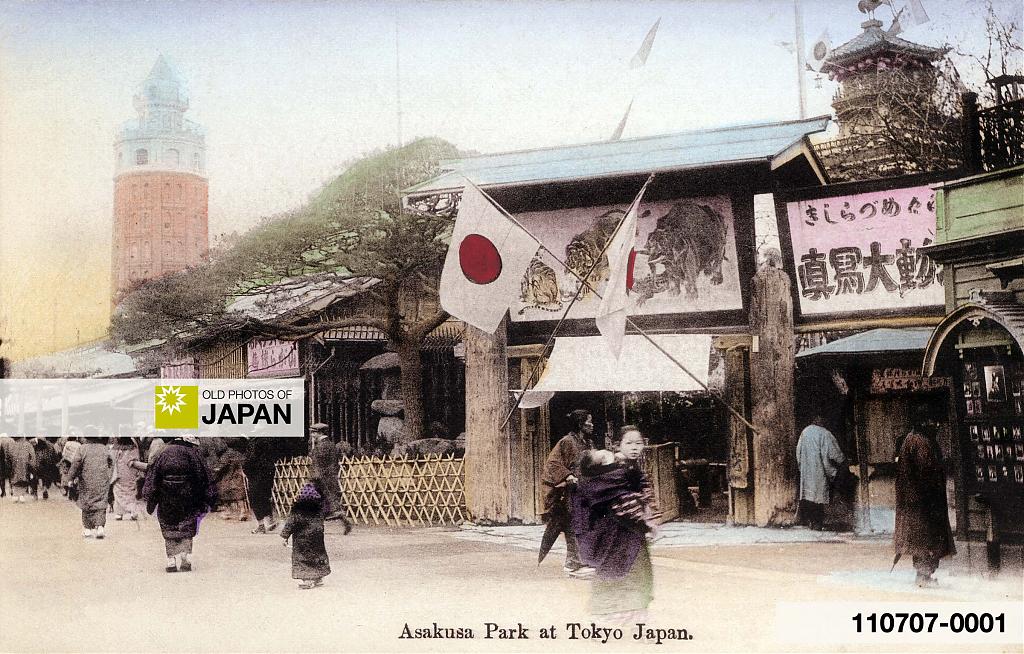
Asakusa Park was to Meiji Tokyo what Shibuya is today, a place for the middle and lower class masses to go and amuse themselves at low cost. Amusement park Hanayashiki was the top crowd puller here.
Opened as a flower park in 1853 (Kaei 6) by a gardener named Rokusaburo Morita, it soon began its amazing transformation into an amusement center with tea shops, entertainment and animal exhibits.
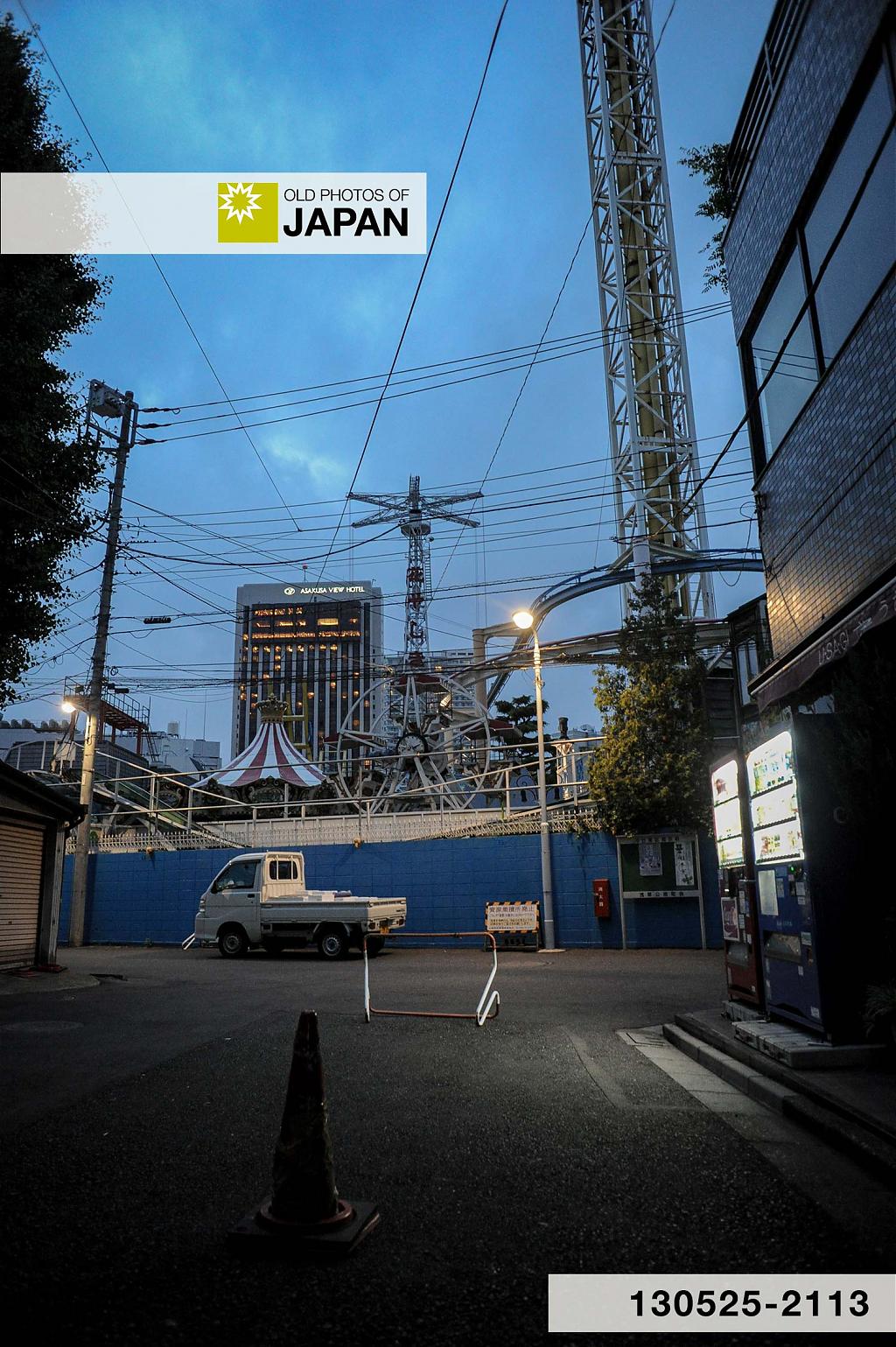
Although the words hanayashiki (花屋敷) and yuenchi (遊園地) nowadays make Japanese immediately think of amusement parks, they originally had quite different meanings. Hanayashiki referred to public flower gardens, while yuen was the Japanese translation for park. Asakusa’s Hanayashiki, generally seen as Japan’s very first amusement park, played an important role in altering these meanings.
Hanayashiki’s metamorphosis started around 1872 (Meiji 5) with the installation of “exercise machines.” Around 1883 (Meiji 16), the first pavilions were opened. But it took a young lumber dealer by the name of Kinzo Yamamoto to make the transformation complete after he became manager of the park in the late 1880s.
He had a five-story pavilion called Ozankaku transferred to the park in 1887 (Meiji 20). This “skyscraper” enthralled visitors when it was opened in 1888, two years before the opening of the 12-story Ryounkaku. The following year, a diorama gallery displaying historical scenes was constructed. A year after, a gramophone was installed at Ozankaku, followed by a merry-go-round. The park also introduced exotic birds, animals and movies.1
Yamamoto’s efforts were a great success. “Hanayashiki, located in the fifth district of the park, is the No. 1 entertainment place in the park,” proclaimed a contemporary source published in 1903 (Meiji 36).2
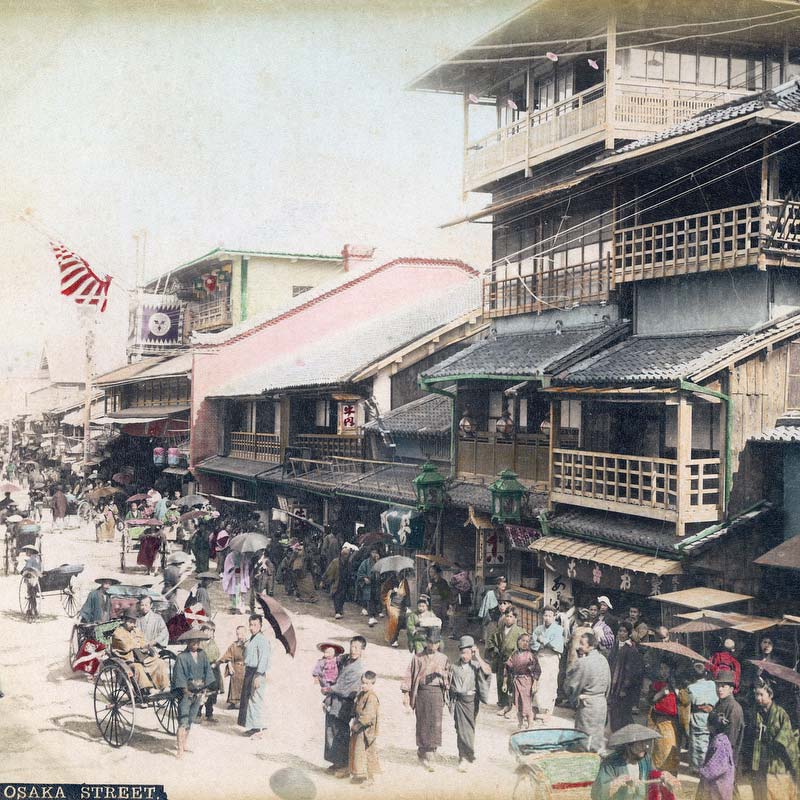
The area next to Hanayashiki followed its example. Japan’s first Ferris wheel was transferred to this location from a fair held in Ueno Park in 1907 (Meiji 40) and a large number of theaters for plays and movies were build.
Hanayashiki never stood still. The world’s first tiger quintuplets were born here in 1923 (Taisho 12) and it was here that the first birth of a lion in Japan took place in 1931 (Showa 6).3
The combination of zoo and amusement park, first explored by Hanayashiki, became so popular that it can still be seen in Japan today. Until Tokyo Disneyland was opened in Chiba in 1983 (Showa 58), animal exhibits were a mainstay of Japanese amusement parks. Many Japanese zoos still offer rides for children.
When the Togo Company took over operations of the park in 1949 (Showa 24), a host of new rides were introduced. In January 2004 (Heisei 16) Togo declared bankruptcy and sold Hanayashiki to Bandai, a Japanese toy company, which to this very day runs Hanayashiki as a popular, albeit very small, amusement park.
In a way, the park has mirrored Japan’s own remarkable transformation. It opened in the same year that Commodore Perry‘s Black Ships arrived at Uraga Harbor and has been able to adjust itself to the times ever since.

Notes
1 National Diet Library, Asakusa Hanayashiki: Transformation from a Park to an Amusement Park. Retrieved on 2008-03-26.
2 岩崎徂堂 (Iwasaki, Sodou) (1903). 新事業発見法 (Shinjigyou Hakkenhou). 東京:大学館 (Tokyo: Daigakkukan), 103.
3 Asakusa Hanayashiki, Asakusa Hanayashiki. Retrieved on 2008-03-26.
Published
Updated
Reader Supported
Old Photos of Japan aims to be your personal museum for Japan's visual heritage and to bring the experiences of everyday life in old Japan to you.
To enhance our understanding of Japanese culture and society I track down, acquire, archive, and research images of everyday life, and give them context.
I share what I have found for free on this site, without ads or selling your data.
Your support helps me to continue doing so, and ensures that this exceptional visual heritage will not be lost and forgotten.
Thank you,
Kjeld Duits
Reference for Citations
Duits, Kjeld (). Tokyo 1920s: Hanayashiki, Asakusa Park, OLD PHOTOS of JAPAN. Retrieved on August 8, 2026 (GMT) from https://www.oldphotosjapan.com/photos/53/hanayashiki-asukusa-park


Herbalife
Wow, it is amazing to compare the landscapes of Japan from the past to the landscape of today. Obviously there’s so much more culture in the buildings of the past, than the industrial towers of today’s cities.
#000017 ·