
Typical rural houses near Nara. It is late April or early May as can be seen from the Koinobori streamers fluttering in the wind in celebration of Boys’ Day on May 5.
The day is still popular and many a Japanese has nice childhood memories of singing songs like the following:
屋根より高い鯉幟 Higher than the roof-tops are the koinobori
大きな真鯉はお父さん
小さな緋鯉は子供たち
面白そうに泳いでる
The large Black Carp is the father
The smaller Golden Carp are the children
They seem to be having fun swimming
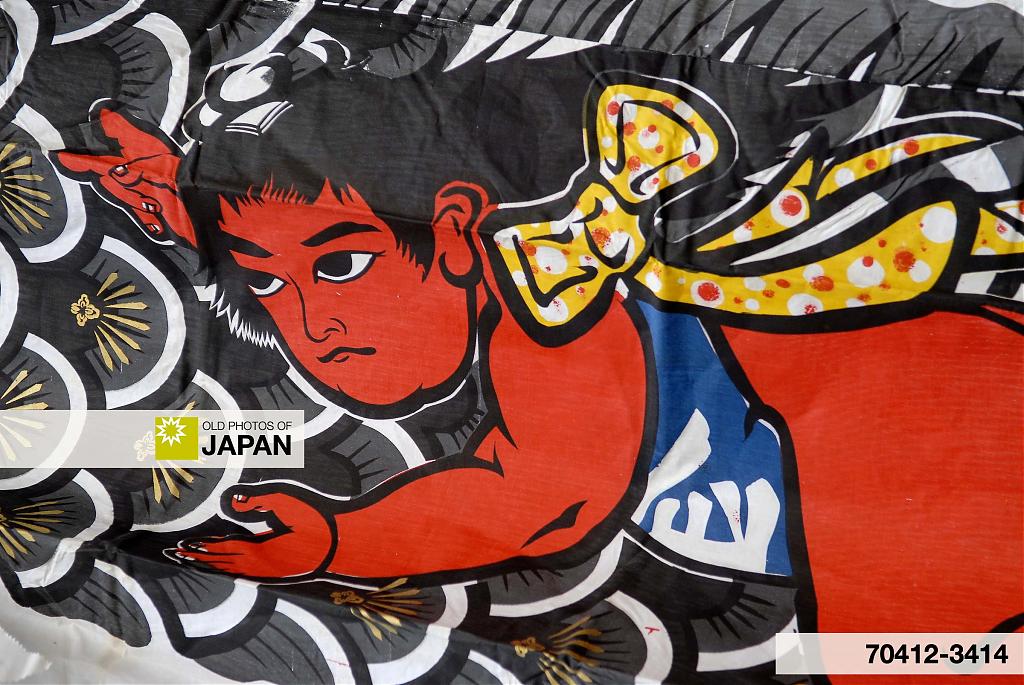
Often koinobori contained a drawing of the mythical folk hero Kintaro. The carp symbolized endurance, while Kintaro was a child of superhuman strength and courage. So his image was used in the hope that the sons of the house would become equally brave and strong.
Kintaro’s story is believed to have been based on the life of a warrior called Sakata no Kintoki (坂田公時) who lived during the Heian Period (794-1185). There is a shrine, called Kintoki Shrine (公時神社 or 金時神社), dedicated to Kintaro at the foot of Hakone‘s Mt. Kintoki.
Boys’ Day was originally known as Tango no sekku (端午の節句). It was one of five annual ceremonies that were held at the Japanese imperial court. The name was changed to Children’s Day in 1948 (Showa 23) to include both male and female children.
This glass slide is one of a series of slides of Japan that was used by the New York State Education Department to teach students about Japan.
Published
Updated
Reader Supported
Old Photos of Japan aims to be your personal museum for Japan's visual heritage and to bring the experiences of everyday life in old Japan to you.
To enhance our understanding of Japanese culture and society I track down, acquire, archive, and research images of everyday life, and give them context.
I share what I have found for free on this site, without ads or selling your data.
Your support helps me to continue doing so, and ensures that this exceptional visual heritage will not be lost and forgotten.
Thank you,
Kjeld Duits
Reference for Citations
Duits, Kjeld (). Nara 1934: Rural Houses, OLD PHOTOS of JAPAN. Retrieved on May 7, 2026 (GMT) from https://www.oldphotosjapan.com/photos/455/rural-houses

There are currently no comments on this article.