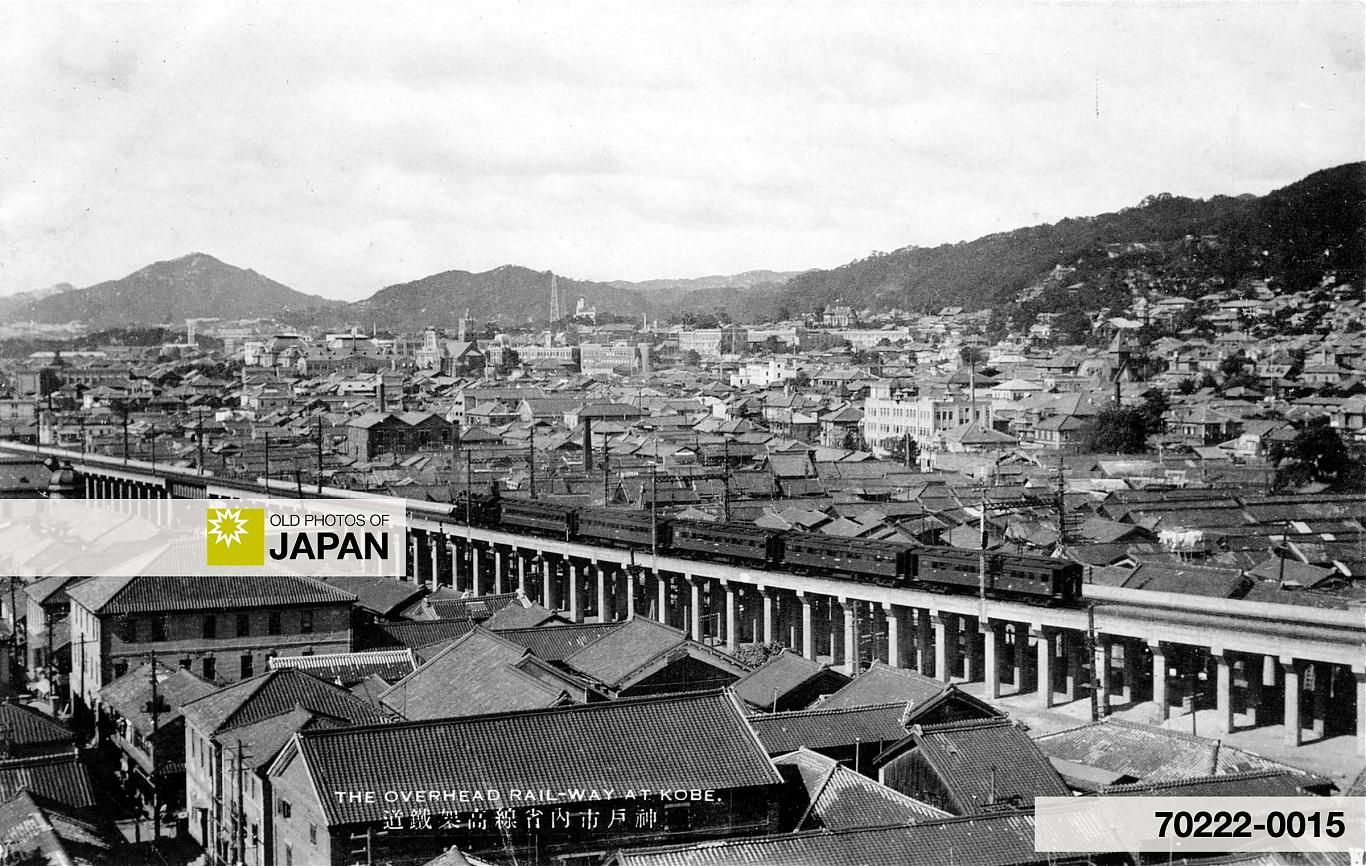
A steam locomotive pulls passenger cars on elevated railway tracks in Kobe.
When the railroad connection between Kobe and Osaka was opened in 1870 (Meiji 3), Kobe was still a small town and the tracks didn’t appear to be in the way. But as the town grew, the tracks ended up being right in the middle of the city center, cutting the town in half.
As traffic increased, this division turned into a major drawback. So in October 1931, the tracks were elevated. In neighborhoods that attracted many people, shops and even some homes were built under the tracks, people didn’t seem to mind the thundering trains above their heads…
During WWII the area below the tracks serviced as a welcome shelter for countless people who lost their homes to fire bomb raids.
The mountain on the far left is Takatoriyama, which has a Shinto shrine that offers an amazing view of Kobe, its harbor and Osaka Bay. From here you can see as far as Kansai Airport and Wakayama Prefecture. On New Year’s Day the place is crowded with people who want to catch the first rays of the first sunrise of the year.
For more information about the railway in Kobe, read Kobe 1900s • View from Aioibashi and Osaka 1930s • Osaka Station.
The Google map shows Daimura near current Motomachi Station, this photo was shot in this general vicinity.
Published
Updated
Reader Supported
Old Photos of Japan aims to be your personal museum for Japan's visual heritage and to bring the experiences of everyday life in old Japan to you.
To enhance our understanding of Japanese culture and society I track down, acquire, archive, and research images of everyday life, and give them context.
I share what I have found for free on this site, without ads or selling your data.
Your support helps me to continue doing so, and ensures that this exceptional visual heritage will not be lost and forgotten.
Thank you,
Kjeld Duits
Reference for Citations
Duits, Kjeld (). Kobe 1930s: Elevated Railway Tracks, OLD PHOTOS of JAPAN. Retrieved on September 10, 2026 (GMT) from https://www.oldphotosjapan.com/photos/431/elevated-railway-tracks


Tornadoes28
I thought it was interesting seeing the elevated tracks in Tokyo with the shops and yakitori stands underneath them. In the US, elevated tracks are not too popular because people feel they are ugly and noisy.
#000278 ·
Kjeld Duits (Author)
They are right. They are very ugly and noisy. Unfortunately, about the majority of the tracks in Japan’s big cities are now elevated…
#000279 ·
Tim Morrill
Today, from Sannomiya to past Motomachi Station to the east, one can walk under the JR tracks. The passageway is lined with all kinds of shops oriented toward young people. It’s so crowded on weekends one can barely pass through, however it certainly is an interesting stroll.
#000529 ·
Kjeld Duits
@Tim Morrill: I love that walk!
#000530 ·
Takahiro Uryu
We can see the building and radio tower of the Kobe Marine Meteorological Observatory on the distant hill in the center of the photo. It opened in 1920 as Japan’s first marine meteorological observatory and provided meteorological communications for ships, but was destroyed in the 1995 earthquake and relocated.
#000830 ·
Kjeld Duits (Author)
@Takahiro Uryu: That is very helpful information, Takahiro. Thank you for sharing!
#000831 ·