
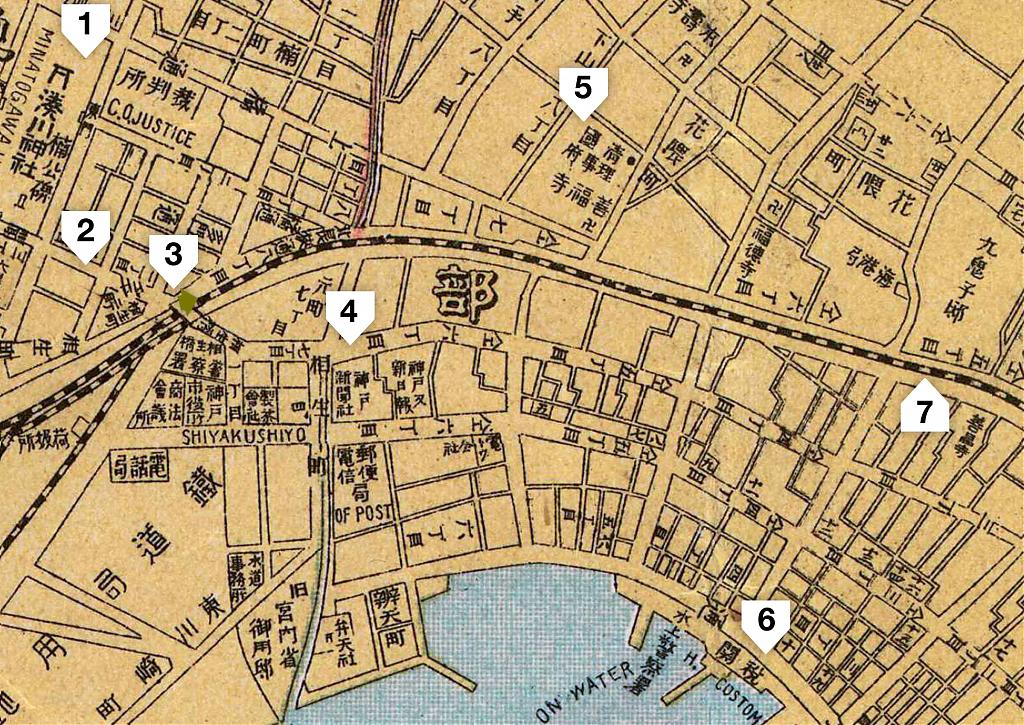
A steam locomotive pushes wagons on the Tokaido railway line. The photographer was standing on Aioibashi bridge, a railway overpass, looking east with his back towards Kobe Station.
The railroad connection between Kobe and Osaka was opened in May 1874 (Meiji 7). It took 70 minutes to travel the 32.7 kilometer route. Today it is a little over 20 minutes.
In 1876 (Meiji 9), the line was extended to Kyoto and by 1889 (Meiji 22) passengers could travel between Kobe and Shinbashi Station in Tokyo.
Aioibashi connected Motomachidori, a major shopping street, with Tamondori and Minatogawa Jinja, one of the most important shinto shrines in Kobe.1
The railroad connection between Kobe and Osaka offered engineers a lot of challenges, which created a whole string of firsts for Japan. The first railroad tunnels below rivers were made; under Sumiyoshigawa and Ashiyagawa. The word tunnel was actually first used in Japan for the Ashiyagawa tunnel, which was such an engineering feat that even The Illustrated London News mentioned it. Several iron railroad bridges were also laid, to cross the rivers Mukogawa, Kanzakigawa and Jusogawa.

Not only the train tracks and steam locomotive are of interest on this photo. It also gives a good impression of a typical street in Kobe. The corner house on the left stood on Tamondori 1-chome and for a long time featured a shop selling cotton. Many more shops can be seen along the railroad line.
In the curve of the railroad was the location of Zenpukuji (善福寺), a temple of the Jodo Sect Honganji Branch of Buddhism. Its roof can be seen through the steam of the locomotive, right above the cabby. Almost right between Aioibashi and the temple, the tracks crossed the Ujigawa River. These days, this river flows underground in this area. It actually disappears underground close to Kobe Central Library, where I do much of the research for the photographs on this site.
The many people walking on wooden geta, a substantial number of them pushing carts, and the sounds of the passing trains must have made this corner of Kobe quite a noisy one. Comparable to the noise of the nearby harbor.
Notes
1 Metadata database of Japanese old photographs in Bakumatsu-Meiji Period, 1039 Train Tracks near Kobe Station (1): Looking East from Aioi Bridge (Kobe). Retrieved on 2008-07-20.
Published
Updated
Reader Supported
Old Photos of Japan aims to be your personal museum for Japan's visual heritage and to bring the experiences of everyday life in old Japan to you.
To enhance our understanding of Japanese culture and society I track down, acquire, archive, and research images of everyday life, and give them context.
I share what I have found for free on this site, without ads or selling your data.
Your support helps me to continue doing so, and ensures that this exceptional visual heritage will not be lost and forgotten.
Thank you,
Kjeld Duits
Reference for Citations
Duits, Kjeld (). Kobe 1900s: View from Aioibashi, OLD PHOTOS of JAPAN. Retrieved on August 8, 2026 (GMT) from https://www.oldphotosjapan.com/photos/305/aioibashi-en

There are currently no comments on this article.