
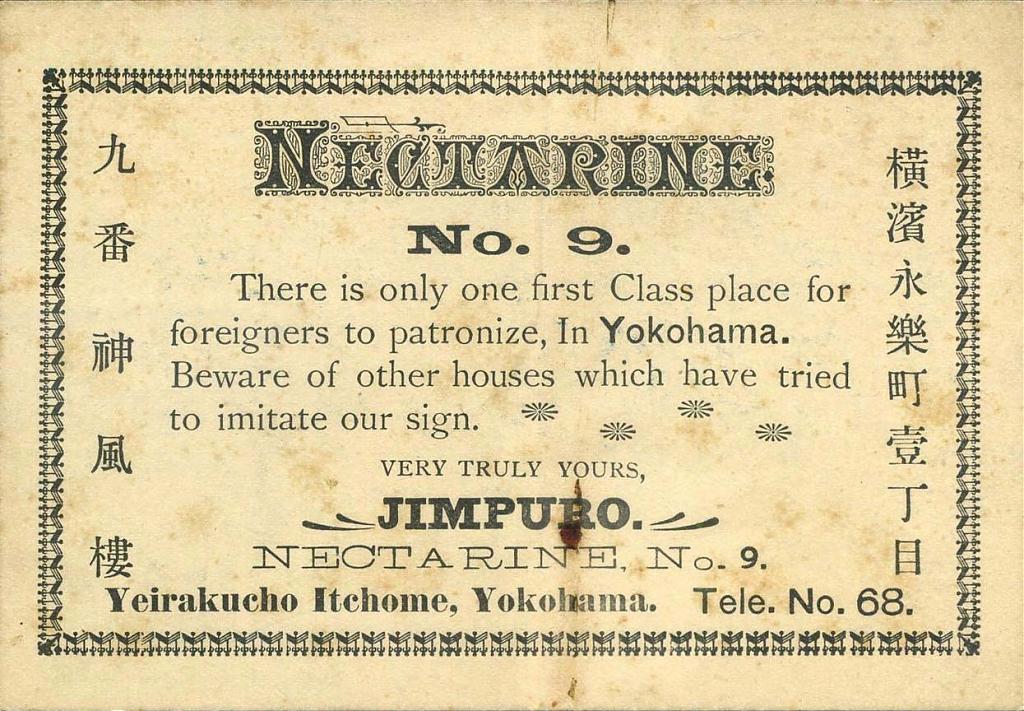
Gorgeously dressed prostitutes are standing in the windows of the Nectarine brothel in Yokohama, a world-famous house of prostitution also known as No.9 or Jimpuro (新風楼, occasionally romanized as Jinpuro or Shinpuro).
Until the Great Kanto Earthquake of 1923 (Taisho 12), Jimpuro was one of the top brothels of the city.1 It was originally opened in 1872 (Meiji 5) in Yokohama’s Takashima-cho (高島町). In 1882 (Meiji 15), Jimpuro moved to the less visible area of Eiraku-cho (永楽町).
An additional branch specifically for foreigners was opened at the red-light district of Kanagawa’s Nanaken-machi (七軒町).2
The brothel was called No. 9, because this was Jimpuro’s original address in Takashima-cho.
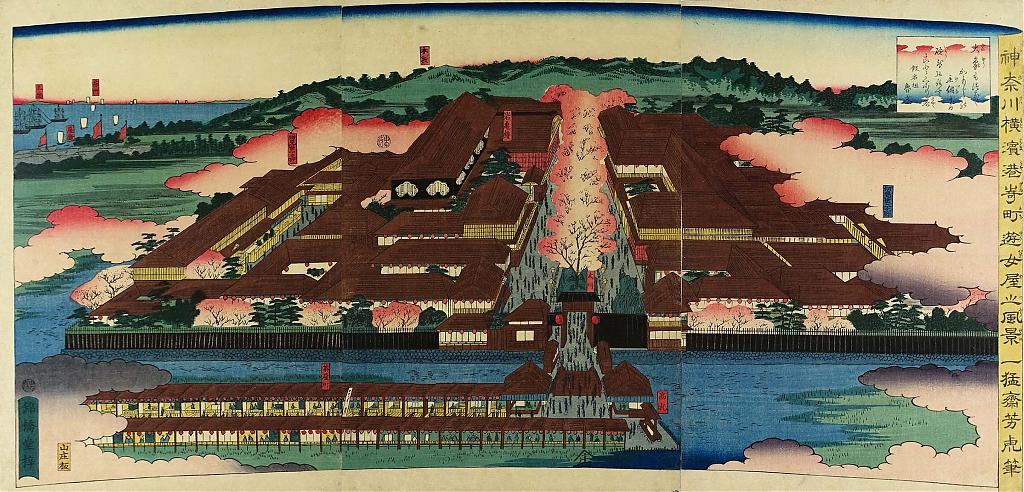
Not only Jimpuro moved. The whole of Yokohama’s licensed prostitution quarter actually moved several times during its existence. In 1866 (Keio 2), a disastrous fire erased the original licensed quarter of Miyozaki-cho. A new one was built to the west, but this one burned down, too. So in 1872 the red-light disctrict of Takashima-cho was built on the reclaimed Noge inlet.
As it happens, this area was clearly visible from the trains that began running that year between Yokohama and Shimbashi Station in Tokyo3. The Japanese government, eager to portray Japan as a modern and civilized country, therefore decided to move the quarter to Eiraku-cho during the early 1880s.4
The huge and extravagant Jimpuro was notorious all over the world, allowing English author and poet Rudyard Kipling to pay tribute to it in his poem McAndrew’s Hymn:
Years when I raked the ports wi’ pride to fill my cup o’ wrong Judge not, O Lord, my steps aside at Gay Street in Hong-Kong! Blot out the wastrel hours of mine in sin when I abode Jane Harrigan’s an’ Number Nine, The Reddick an’ Grant Road!
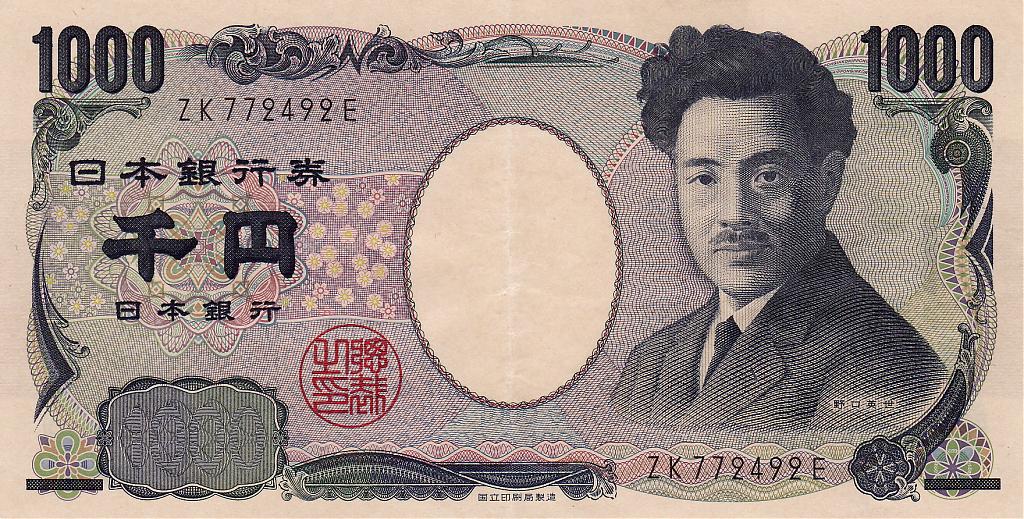
Jimpuro was not only popular with foreigners, but with Japanese men as well. In 1900 (Meiji 33), bacteriologist Hideyo Noguchi (1876-1928), who now graces Japan’s 1,000 yen bill and was nominated for a Nobel Prize three times, blew almost 500 yen (a small fortune at the time) at Jimpuro during a single night of pleasure. Some 300 yen of that he had received from an acquaintance, on condition that he marry her niece. Even worse, part of the money was supposed to have been used for the purchase of a ticket for passage to America.
He managed to borrow money from a friend and did make it to the States, where he eventually became a top bacteriologist at the Rockefeller Institute of Medical Research, and very appropriately isolated the syphilis bacterium.
Noguchi never married the niece, though, and left the repayment of the 300 yen to the same friend he borrowed money from for the ticket to the USA.5
Undoubtedly, Noguchi was not the only man to so foolishly waste his money on Jimpuro’s food, women and wine.
For more information about Japan’s licensed prostitution, click on Prostitution in the Themes menu.
The Google map shows the location of Yokohama’s Eiraku-cho. I haven’t yet been able to locate the exact location of Jimpuro.
Notes
1 Metadata database of Japanese old photographs in Bakumatsu-Meiji Period. Courtesans of Jimpuro brothel (2).
2 Metadata database of Japanese old photographs in Bakumatsu-Meiji Period. Jimpuro (3).
3 For more information about Japan’s first railroad, read Yokohama 1873 • Bentenbashi and Station and Yokohama 1900s • Yokohama Station.
4 Sabin, Burritt (Nov 3, 2002). Yokohama: city of wide horizons. The Japan Times.
5 Kawabata, Tai (Nov 21, 2004). Funny Money. Discordant notes… The Japan Times.
Published
Updated
Reader Supported
Old Photos of Japan aims to be your personal museum for Japan's visual heritage and to bring the experiences of everyday life in old Japan to you.
To enhance our understanding of Japanese culture and society I track down, acquire, archive, and research images of everyday life, and give them context.
I share what I have found for free on this site, without ads or selling your data.
Your support helps me to continue doing so, and ensures that this exceptional visual heritage will not be lost and forgotten.
Thank you,
Kjeld Duits
Reference for Citations
Duits, Kjeld (). Yokohama 1890s: Nectarine No. 9 Brothel, OLD PHOTOS of JAPAN. Retrieved on August 12, 2026 (GMT) from https://www.oldphotosjapan.com/photos/284/nectarine-no-9-brothel


Allan
Really amazing, to see all these old photos from Japan, and knowing, and having visited and seen the areas myself in the last 5 years, I can relate to them well.
Allan (New Zealand)
#000293 ·
Orchid64
Pictures like these make me sad. I can’t imagine the lives of of the women who were “employed” in these brothels. Given the status of women at that time, I’d guess they were unwanted daughters or forced into this work. It’s not so different from brothels in Japan now except that now most of the employees are from other countries.
#000340 ·
Kjeld Duits (Author)
Life in the brothels was indeed hard. I will write a description of the extremely lonely death of a prostitute in a future article. But they weren’t unwanted daughters. In many cases parents were forced to sell their daughters because of unimaginable poverty, in other cases, it was the only way for a woman to earn money independently. Then there were the many daughters who had broken some rule and were forced by their family to temporarily prostitute themselves as a way to teach them a lesson. This often happened in samurai families.
#000341 ·
Puck
The image in the 1000 Yen bill above is
of Natsume Soseki and not Hideyo Noguchi
#000532 ·
Kjeld Duits
@Puck: Thanks! That was an embarrassing mistake. Fixed it!
#000533 ·
Noel
I have a hard time pinpointing the location of the building in the main photograph by Kimbei. If we assume it was Kimbei’s original (not a negative acquired from another studio) it should be Eiraku-cho, however it’s not the same building as in the business card shown above. Any guesses?
#000659 ·
Kjeld Duits (Author)
Hi Noel,
Good to hear from you. I haven’t yet quite figured this out myself. Over the years, Jimpuru was rebuilt several times. The building in the business card is always shown in postcards, so could be the building that came after the one in the top photo.But at this point, I am just speculating.
#000660 ·
Noel
I managed to identify two locations in Takashima-cho, one at Eiraku-cho and the Kanagawa Branch, however this one remains a mystery to me. One would think, that such a famous establishment would be described in detail (just like Yoshiwara district) in books or research papers, but all I’ve found were just tiny bits of information.
#000661 ·
Kjeld Duits (Author)
I wish I could be of more help, Noel. My gut feeling has been that both this building and the one on the business card were at the same location. But I have not been able to confirm or disprove that hypothesis yet… Have you been in contact about this with the Yokohama Archives of History?
#000662 ·
Kjeld Duits (Author)
Noel, the Nagasaki University Library calls this building 高島町神風楼 (Takashima Jinpuru The business was located at Takashima-cho 2-chome from 1871 to 1885. I can’t imagine they had several buildings in such a short time span, though…
#000663 ·
Noel
Although I often use The Nagasaki Database as a reference, I’ve also noticed that many photographs were incorrectly identified or described. For example, the Kanagawa Branch is also titled 高島町神風楼.
On the other hand your recommendation of Yokohama Archives was on target. I found an article on Jinpuro in their newsletter/ magazine “Kaikoku no hiroba”. My Japanese got a little rusty, so it will take some time until I translate it.
#000664 ·
Kjeld Duits (Author)
@Noel: Yes, the Nagasaki University Library Database has some problems. I find their historical descriptions usually dependable, but their attributions are often incorrect.
I think I may have seen the article of Yokohama Archives you are referring to. Quite long. In a very quick scan I couldn’t find the info we are looking for. But it may be hidden in there.
#000665 ·
Noel
The article still sits on my desktop untranslated, but recently I came across an interesting piece of information. Cit. “It was in 1877 when Sennosuke Yamaguchi decided to establish an inn catering only to international visitors in Miyanoshita. He bought Fujiya Inn, a Japanese-style inn, that name meant Wisteria Inn, not Mt.Fuji. He re-opened it in 1878 under the name Hakone Miyanoshita Fugakukan Fujiya Hotel as a branch of Yokohama Jinpuro Inn where his adoptive father Kumezo Yamaguchi worked as a manager. “ source
The name of Kumezo Yamaguchi also pops up in the beginning of said article and as far I could understand he was managing “Nectarine” at Takashima-cho.
#000704 ·
Kjeld Duits (Author)
@Noel: What a coincidence!
I am currently doing research for a book, and found this article just a few days ago.
I also found that 横浜市史稿 (Yokohama Historical Documents) has a very detailed volume about the Sex Industry in Yokohama: 風俗編, which probably answers all our questions about the locations.
#000705 ·
Kjeld Duits (Author)
@Noel: By the way, how do you like the new look?
#000706 ·
Noel
The new design is definately modern, clean and inviting. Although I also liked the previous design, which gave the website that warm, “antique” feel. I only wish you had kept the “recent comments” feature on the main page, so that the visitors like me could follow ongoing discussions.
#000707 ·
Kjeld Duits (Author)
@Noel: Your request is my command!
In the About menu, you can now find a Recent Comments link
#000708 ·
Tedley
I’m late to the conversation, but in the history classes I took at Sophia Univ. a few years ago, the red light district nearest to the treaty port was roughly where the baseball stadium is today. This is much closer than Eiraku-cho, although it may have moved to Eiraku-cho after the major fire that burned down most of the buildings in the stadium area. On the other hand, I don’t remember hearing anything about there being houses of ill repute in Takashima-cho 2-chome, that’s news to me.
You might be wondering why I’m replying to this blog post now. It so happens that I was flipping through a stack of old Yokosuka and Yokohama ehagaki in a store in Jimbocho today, and found a couple featuring women that said something like “building no. 9” in Yokohama. When I Googled the term, this site was one of the first that came up, a funny coincidence.
As far as why it’s hard to find good sources of info on them, it doesn’t fit well with the moral code of the time, whether it was the morality that Japan inherited from China or the Christianity that Western nations brought. The red light districts which received official blessing during the Edo Period, such as Yoshiwara and a couple in Osaka, were always located off the beaten path (Yoshiwara was the second, if memory is right, since Edo expanded to encompass the first one). While prostitution was accepted, the Shogun wanted it controlled in a confined area so it could be monitored. They were less accepting of unofficial red light districts, although they did exist—I vaguely remember one being at Fukagawa.
#000918 ·
Kjeld Duits (Author)
@Tedley: Glad that you ended up here, Tedley. At which store in Jimbocho did you find the ehagaki? Nagamori Shoten?
The Tokugawa Shogunate did indeed try very hard to control prostitution, but there still was lots of unlicensed prostitution going on. During the Meiji Period much of that was made official and suddenly there were red light districts all over…
#000919 ·
Tedley
Yes, I figured you’d know about it. Are you a frequent shopper there?
#000922 ·
Kjeld Duits (Author)
@Tedly: I only visit a handful of times a year, but they have a wonderful collection. It’s the only shop left in Jimbocho worth visiting for ehagaki. There used to be quite a few…
#000923 ·