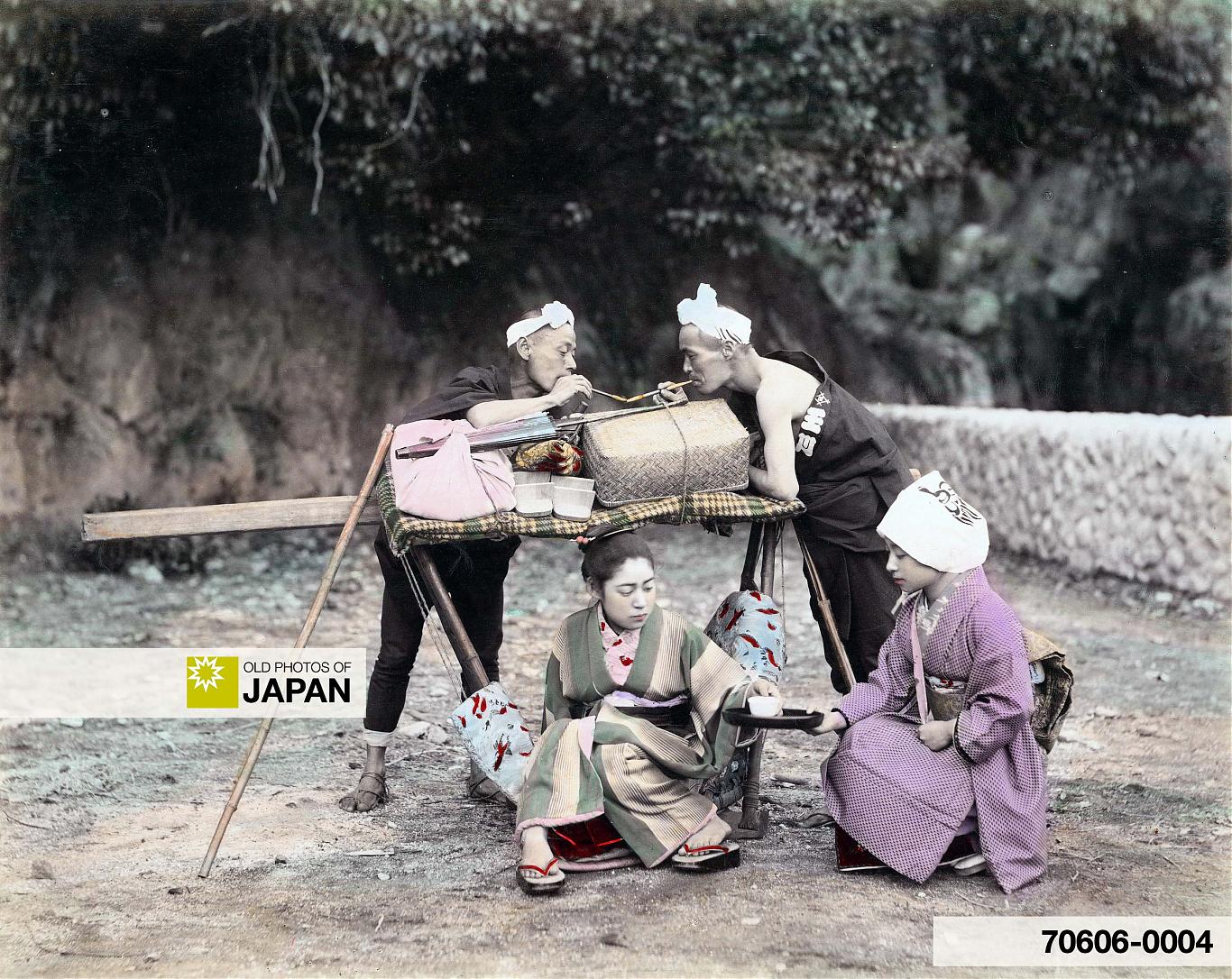
During a break, two kago bearers smoke kiseru pipes while their customer is being served tea by a waitress from a teahouse.
The woman’s luggage is tied to the roof of the kago. During the Edo Period, (1603-1868) only samurai were allowed to ride horses, while horse carriages were unknown. The kago therefore was Japan’s main mode of transportation until the invention of the jinrikisha (rickshaw) around 1868.
The jinrikisha quickly replaced the kago in the cities (Tokyo for example had already some 56,000 jinrikisha in 18721), but its use continued in mountainous areas where the jinrikisha was often not practical.
The kago customer would squat in a semi-recumbent posture. Japanese were used to this, accustomed as they were to sitting on the floor. But to many foreign visitors, the kago was a painful experience about which they often complained in their diaries.
See another image of a kago at 1880s • Woman in Kago.
Notes
1 March, Roger (2007). How Japan Solicited the West: The First Hundred Years of Modern Japanese Tourism. University of New South Wales, 2.
Published
Updated
Reader Supported
Old Photos of Japan aims to be your personal museum for Japan's visual heritage and to bring the experiences of everyday life in old Japan to you.
To enhance our understanding of Japanese culture and society I track down, acquire, archive, and research images of everyday life, and give them context.
I share what I have found for free on this site, without ads or selling your data.
Your support helps me to continue doing so, and ensures that this exceptional visual heritage will not be lost and forgotten.
Thank you,
Kjeld Duits
Reference for Citations
Duits, Kjeld (). 1890s: Kago Bearers Taking a Break, OLD PHOTOS of JAPAN. Retrieved on May 7, 2026 (GMT) from https://www.oldphotosjapan.com/photos/283/kago-bearers-taking-a-break
There are currently no comments on this article.