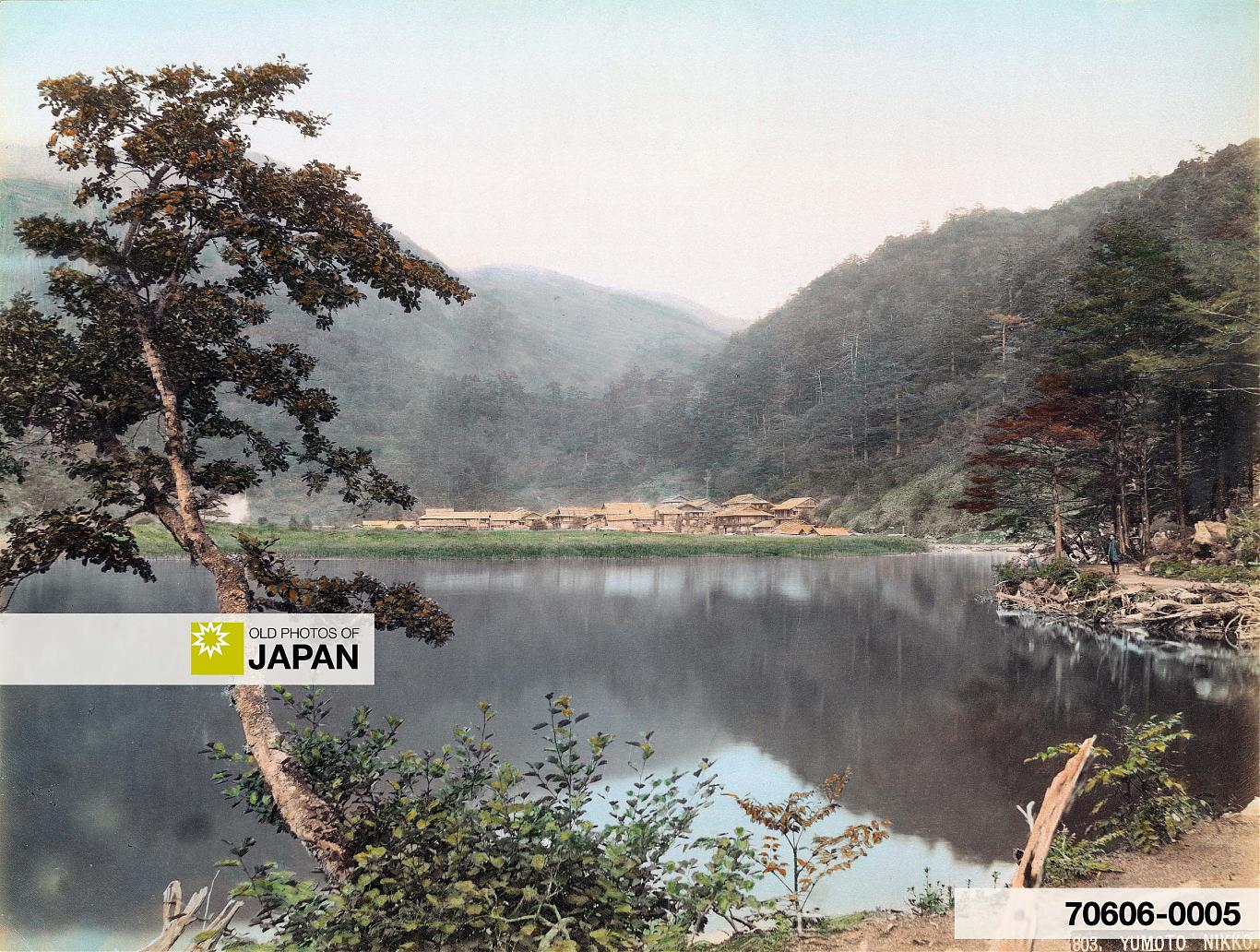
A view of Lake Yunoko (湯の湖) and the hot spring hotels of Yumoto (湯元), near Nikko in Tochigi Prefecture.
Hemmed in by mountains, there barely seems enough place for both a lake and a spa resort, but they did somehow manage to squeeze themselves in.
Yumoto’s sulphur baths have attracted weary travelers and people hoping to heal their body and soul for many centuries, and still do so today. Priest Shodo (勝道上人, 735-817), who founded the two temples which became the origin of Nikko, is said to have found the hot spring in 788. He called it Yakushiyu (薬師湯, doctor’s hot spring). During the 14th century, it became extremely popular with aristocrats.
The village was not always called Yumoto. Before the area received its current name, it was called Futarasan Onsen (二荒山温泉), after a nearby mountain.
Yunoko actually means hot water lake. It was called so because water of the hot spring flows into the lake. The water of the lake in its turn feeds the beautiful Yudaki Falls (湯滝) before turning into the Yukawa River (湯川).
Interestingly, women were not permitted to use the hot spring until the Meiji Period (1868-1912). According to ancient Shinto beliefs, they were believed to be unclean. This seems to suggest that the hot spring was considered sacred.
Fortunately, this rule had been abandoned by the time famed British travel writer Isabella Lucy Bird (1831–1904) stayed in Yumoto on June 22, 1878. Bird was the first Western woman to travel into the interior of Japan by herself—albeit with a Japanese guide—and took a trip of many months that saw her travel from Yokohama to Nikko and all the way to Hokkaido where she met with Ainu.
During the first month of her great adventure she wrote the following description of the tiny spa resort to her sister Henny1:
There is scarcely room between the lake and the mountains for the picturesque village with its trim neat houses, one above another, built of reddish cedar newly planed. The snow lies ten feet deep here in winter, and on October 10 the people wrap their beautiful dwellings up in coarse matting, not even leaving the roofs uncovered, and go to the low country till May 10, leaving one man in charge, who is relieved once a week. Were the houses mine I should be tempted to wrap them up on every rainy day! I did quite the wrong thing in riding here. It is proper to be carried up in a kago, or covered basket. The village consists of two short streets, 8 feet wide composed entirely of yadoyas of various grades, with a picturesquely varied frontage of deep eaves, graceful balconies, rows of Chinese lanterns, and open lower fronts. The place is full of people, and the four bathing-sheds were crowded. Some energetic invalids bathe twelve times a day! Every one who was walking about carried a blue towel over his arm, and the rails of the balconies were covered with blue towels hanging to dry. There can be very little amusement. The mountains rise at once from the village, and are so covered with jungle that one can only walk in the short streets or along the track by which I came. There is one covered boat for excursions on the lake, and a few geishas were playing the samisen; but, as gaming is illegal, and there is no place of public resort except the bathing-sheds, people must spend nearly all their time in bathing, sleeping, smoking, and eating. The great spring is beyond the village, in a square tank in a mound. It bubbles up with much strength, giving off fetid fumes. There are broad boards laid at intervals across it, and people crippled with rheumatism go and lie for hours upon them for the advantage of the sulphurous steam. The temperature of the spring is 130 degrees F.; but after the water has travelled to the village, along an open wooden pipe, it is only 84 degrees. Yumoto is over 4000 feet high, and very cold.
A Nishikie (錦絵) published in 1879 (Meiji 12), which is just a year after Bird visited, shows ten inns in Yumoto and not much else. It really was a very small place.
Notes
1 Bird, Isabella L. (1911). Unbeaten Tracks in Japan: An account of travels in the interior including visits to the aborigines of Yezo and the shrine of Nikko. John Murray.
2 For tourist information about Yumoto Spa, visit the official site of the Nikko-Yumoto Visitor Center.
Published
Updated
Reader Supported
Old Photos of Japan aims to be your personal museum for Japan's visual heritage and to bring the experiences of everyday life in old Japan to you.
To enhance our understanding of Japanese culture and society I track down, acquire, archive, and research images of everyday life, and give them context.
I share what I have found for free on this site, without ads or selling your data.
Your support helps me to continue doing so, and ensures that this exceptional visual heritage will not be lost and forgotten.
Thank you,
Kjeld Duits
Reference for Citations
Duits, Kjeld (). Nikko 1890s: Yumoto, OLD PHOTOS of JAPAN. Retrieved on August 6, 2026 (GMT) from https://www.oldphotosjapan.com/photos/282/yumoto

Tornadoes28
Very interesting. I have never been to this area of Nikko. I have been to the Senjogahara Plateau.
#000352 ·
Kjeld Duits (Author)
The village doesn’t look like this at all anymore, I am afraid. Concrete and asphalt have intruded here as well. But the mountains, lake and falls are still spectacular.
#000353 ·
Robert Downing
I purchased an old handcolored photograph that is labeled “J 18, Yumoto, Nikko”. It appears to be a slightly different shot of the view of Lake Yunoko and the hot spring hotels of Yumoto. My guess is that the protographer was positioned to the right to the shore line in the photo you show above.
Can you tell me if it is also by Kimbei Kusakabe? Is there any record of the photo?
Thank you for any information you can provide.
Robert Downing
#000434 ·
Kjeld Duits (Author)
@Robert: I checked Terry Bennett’s Collectors’ Data Guide and it has no listing for J 18, Yumoto, Nikko. J 18 differs from Kimbei Kusakabe’s numbering system, so I am pretty sure that the photo is not by him. According to Bennett, there is actually still a lot of uncertainty about photo numbers starting with letters.
Maybe you can show me a link to a scan of your photo, and I’ll have a look.
#000435 ·
Ilshat Khusnutdinov
Hello. You write that women were forbidden to use hot springs. Does this apply to all onsen, or just this one specifically?
Thank you.
(Translated using Yandex.translate)
#000832 ·
Kjeld Duits (Author)
@Ilshat Khusnutdinov: Thank you for your question. This only applied to Yakushiyu. At most onsen women were quite welcome.
#000833 ·