
This postcard of the early 1930s shows the construction of the Midosuji subway line in Osaka, the city’s first subway line and the first government-operated subway line in Japan.
On May 20, 1933 (Showa 8) the Midosuji line opened between a temporary station in Umeda, in Osaka’s north, and Shinsaibashi in the south. The construction of the subway coincided with the widening of the road from 6 to 44 meters, making Osakans joke that an airplane could land on the newly named Midosuji Avenue.
The stations were built to handle up to eight cars, but only single cars were used at first, making people on the long platforms having to scramble to the spot where the short trains stopped. Quite different from today’s disciplined lines of people at predetermined spots for each train door.
The Umeda-Shinsaibashi section was dug entirely by hand and plagued by the terrible composition of the earth and poor engineering skills. The combination of the two caused much water leakage and cave-ins in the northern construction site during the start of the project.
Footage from the time shows how new technology and traditional methods went hand in hand. Cars for example were hauled onto the line by both machine and oxen, and although there were motorized lifts, workers used shovels to dig (see video below).
Osaka’s modern transportation system had a slow start. Although Tokyo started its first horse-drawn streetcar service as early as 1882 (Meiji 15), Japan’s second-largest city Osaka only started construction of streetcar lines some two decades later in 1903 (Meiji 35). The reason for the slow start was Osaka’s unique urban lay-out. The city had a crowded urban center that was cut up by a tight grid of canals, while streets were extremely narrow. It also had an excellent ferry system. However, the city was growing at such a fast speed that by the turn of the century, the ferries could no longer handle the demand.
To solve these problems, the municipal government widened streets, replaced narrow wooden bridges with large stone and steel constructions and created an extensive electric street car system. Uniquely, the city ran the system itself, using the money it earned to pay off the huge debts it had made to fund the construction.
By the late 1920s, growth had once again overburdened Osaka’s transportation system, and the city fathers decided to build an underground railway system. Much of the impetus for the plan came from Osaka’s scholar mayor Hajime Seki (関一, 1873-1935). He saw the transportation system as an opportunity to link Osaka’s inner city with newly planned suburbs and eradicate Osaka’s appalling poverty in its many buraku and ethnic enclaves. The construction of the Midosuji line was also seen as an opportunity to create work for Osaka’s many unemployed during the Great Depression.
Seki’s vision of an integrated and extensive public transportation network finally came to fruition when Osaka drowned in traffic jams during the economic boom of the 1960s. The city launched an ambitious subway construction program and by 1969 (Showa 44) had created numerous extensions, four completely new lines1 and abandoned virtually all of the city’s streetcar network.
Since its inauguration in 1933, the Midosuji line has been repeatedly extended (see Timeline of Midosuji Subway below). It finally reached its current length of 24.5 kilometers in 1987 (Showa 62). Kita-Osaka Kyuko Railway operates a line that extends from Esaka, making the full line 30.4 kilometers long.
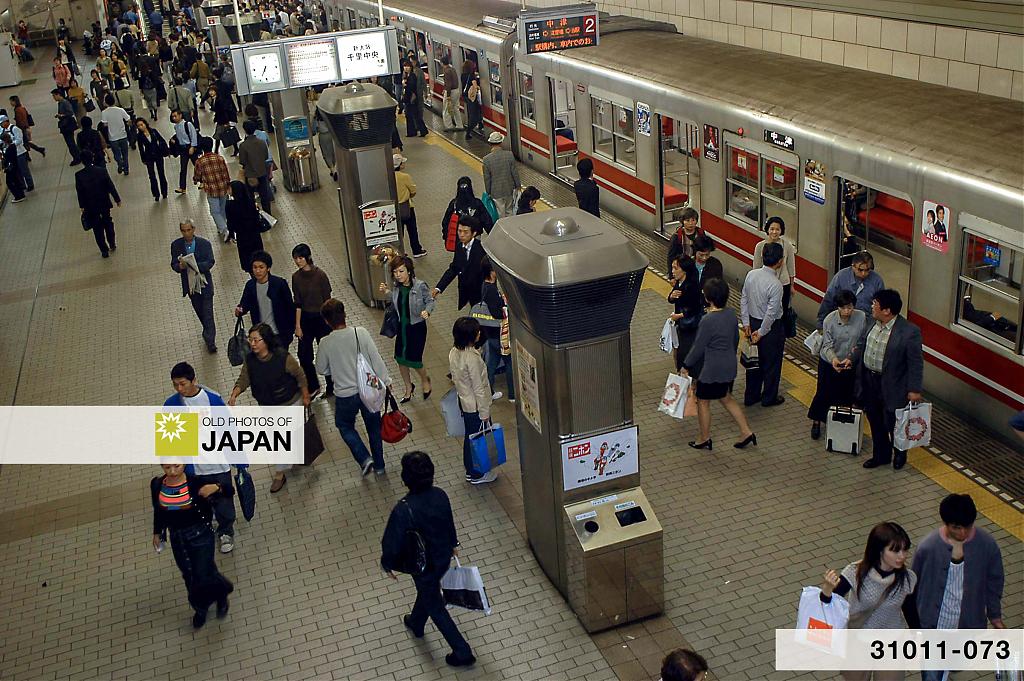
Because the Midosuji line connects to JR West‘s Osaka Station and the terminals of five private railways, it is the busiest subway line in Osaka serving some 459 million passengers per year. During weekly rush hours, 10-car trains service the stations at intervals of an amazing 2-minutes.
The line has transformed Osaka, feeding the city’s new business, shopping and entertainment centers in Umeda, Yodoyabashi, Honmachi, Shinsaibashi and Namba and making it easier for Osaka’s middle class to move out of the city and into the suburbs. Unfortunately, Seki’s dream of eradicating urban poverty and discrimination has yet to come fully true.
Timeline of Midosuji Subway
| 1933 (Showa 8): May 20 | Shinsaibashi - Umeda (temporary station) |
|---|---|
| 1935 (Showa 10): October 6 | Opening of the final Umeda Station |
| 1935 (Showa 10): October 30 | Shinsaibashi - Namba |
| 1938 (Showa 13): April 21 | Namba - Tennoji |
| World War II | Construction stopped |
| 1951 (Showa 26): December 20 | Tennoji - Showacho |
| 1952 (Showa 27): October 5 | Showacho - Nishitanabe |
| 1960 (Showa 35): July 1 | Nishitanabe - Abiko |
| 1964 (Showa 39): September 1 | Umeda - Shin-Osaka |
| 1970 (Showa 45): February 24 | Shin-Osaka - Esaka |
| 1987 (Showa 62): April 18 | Abiko - Nakamozu |
Notes
1 Chuo line (1961), Tanimachi line (1967), Sennichimae line (1969) and the Sakaisuji line (1969). The Yotsubashi line was opened in 1943.
2 Find a current Osaka subway map on the site of the Osaka Metro (multilingual).
Published
Updated
Reader Supported
Old Photos of Japan aims to be your personal museum for Japan's visual heritage and to bring the experiences of everyday life in old Japan to you.
To enhance our understanding of Japanese culture and society I track down, acquire, archive, and research images of everyday life, and give them context.
I share what I have found for free on this site, without ads or selling your data.
Your support helps me to continue doing so, and ensures that this exceptional visual heritage will not be lost and forgotten.
Thank you,
Kjeld Duits
Reference for Citations
Duits, Kjeld (). Osaka 1930s: Digging Midosuji Subway, OLD PHOTOS of JAPAN. Retrieved on July 4, 2026 (GMT) from https://www.oldphotosjapan.com/photos/267/digging-midosuji-subway


Mr. T
Having traveled on Osaka’s mass transit system, it is an engineering marvel. It is delightful to learn more about the history of how it came to be. Thank you for this interesting bit of history.
#000068 ·
Kjeld Duits (Author)
Thank you, Mr. T. I always appreciate your nice comments.
#000069 ·
Mattd
Just a wonderful article. I took the midosuji line from Namba to Umeda daily for about a year in the late 90s. Fascinating to see its history, thank-you.
#000074 ·
Kjeld Duits (Author)
Thank YOU, Mattd. Very glad to hear from a reader. Especially a satisfied one!
#000075 ·
Nsan
I rode the Midosuji when I was in Osaka every day. It was interesting to read the history.
#000147 ·
Sraige
Hi,
Nice addition to the subway’s story. In light of Gochisousan, which has recently become available online, could you expand the information on the construction dates? I am guessing the related Gochicousan episodes on the expansion of Midōsuji Street are set in 1932. Thanks. The series has been a wonderful introduction to Japanese life and history and I would love to learn even more about the history it refers to.
#000657 ·
Kjeld Duits (Author)
Thank you, Sraige!
#000658 ·