
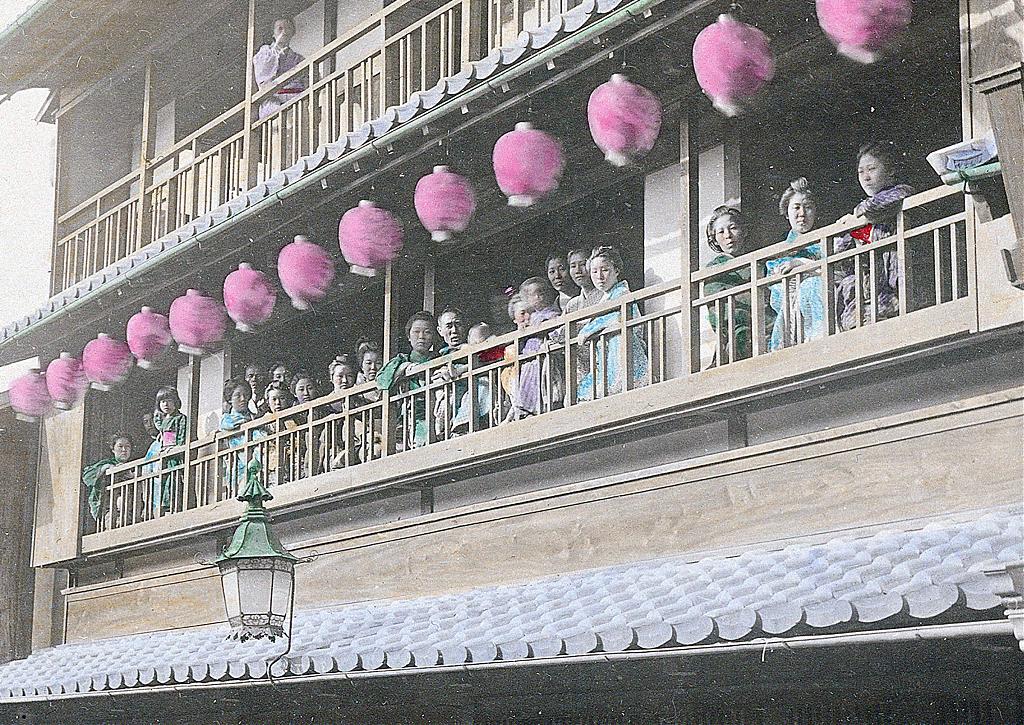
“Tea House” is the innocent and misleading title printed on this image. It is actually a view of the Nagasaki brothels Kinbaro (金波楼), the one with the lanterns, and Tamashimatei (玉島亭), the one next to Kinbaro on the far side.
These were just two of many brothels in Nagasaki’s Maruyama (丸山町) and Yoriai (寄合町) prostitute quarters. At the height of their popularity, Maruyama and neighboring Yoriai counted no less than 54 brothels with 766 prostitutes.
The popularity can easily be deduced from the number of women employed by Kinbaro in this image. Two women stand at the entrance of Kinbaro, while another twenty are on the balcony. There were probably more.
After the Russo-Japanese War (1904-1905), however, times became increasingly difficult in Nagasaki. By 1925 (Taisho 14), Kinbaro employed only 15 prostitutes and neighbor Tamashimatei just 10.1
Maruyama and Yoriai were especially popular with the many sailors that visited Nagasaki. The majority of these sailors hailed from the UK, the US, France, the Netherlands, Russia and Prussia. They just finished long and often dangerous journeys and it showed in their behavior.
A naval surgeon attached to the U.S.S. Iroquois, who arrived in Nagasaki in October 1868 (Meiji 1), has left us a revealing account of this behavior. He describes a favorite game of American sailors, who were locally known as “John Nugi”, derived from the Japanese word for undressing. The game was a grown up version of “Simon Says,” in which a girl had to take off one clothing item each time she lost2:
As soon as the girls are all naked, why, so soon do they commence to perform all manners of tricks, dancing in the most voluptuous manner, placing themselves in all different kinds of attitudes that one might imagine men and women would take whilst having carnal communication with each other. In short, the whole is one carnival of sin and iniquity, the passions of both sexes amused to the highest pitch.
The fun and games in Nagasaki came at a price, many sailors contracted venereal diseases like gonorrhea and syphilis as well as other diseases and quite a few ended up in the city’s foreign cemetery.
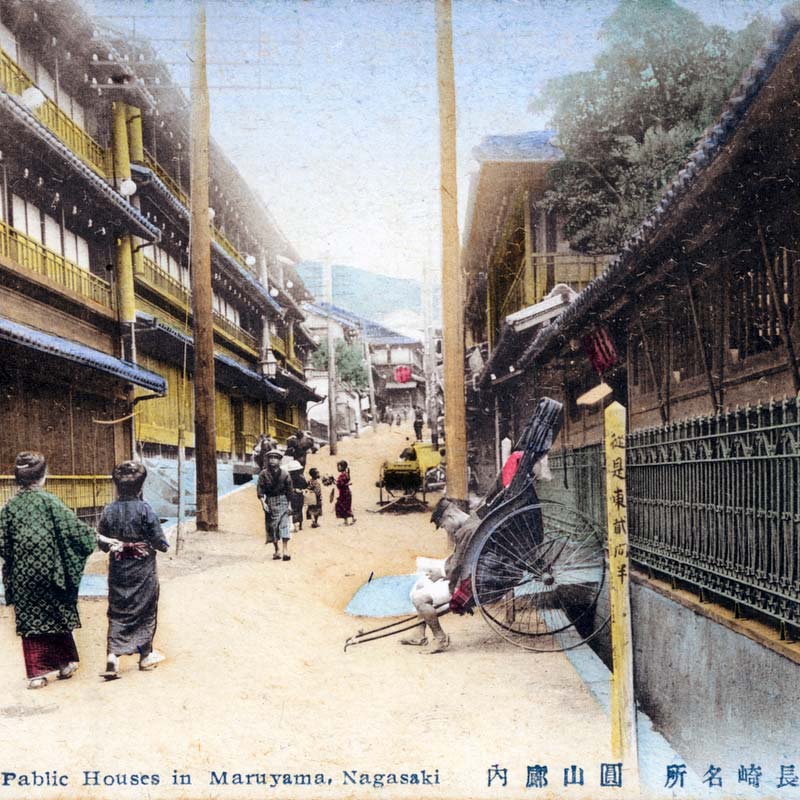
For a later view of the same area, see Nagasaki 1910s • Maruyama Brothels.
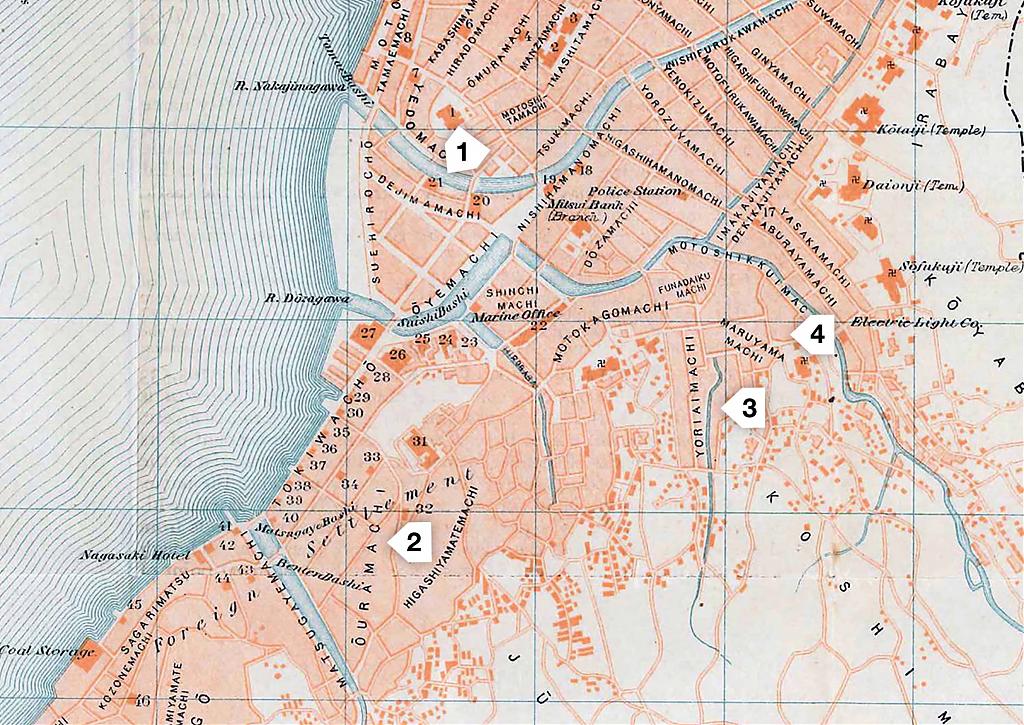
As I haven’t discovered the exact location of this image yet, the Current Map shows the center of the Maruyama district.
Notes
1 Metadata database of Japanese old photographs in Bakumatsu-Meiji Period, 3877 Maruyama brothel district. Retrieved on 2008-06-06.
2 Boyer, Samuel P. (1963). Naval Surgeon: Revolt in Japan, 1868-1869. Indiana University Press, 102-103.
Published
Updated
Reader Supported
Old Photos of Japan aims to be your personal museum for Japan's visual heritage and to bring the experiences of everyday life in old Japan to you.
To enhance our understanding of Japanese culture and society I track down, acquire, archive, and research images of everyday life, and give them context.
I share what I have found for free on this site, without ads or selling your data.
Your support helps me to continue doing so, and ensures that this exceptional visual heritage will not be lost and forgotten.
Thank you,
Kjeld Duits
Reference for Citations
Duits, Kjeld (). Nagasaki 1890s: Maruyama Brothels, OLD PHOTOS of JAPAN. Retrieved on August 8, 2026 (GMT) from https://www.oldphotosjapan.com/photos/260/maruyama-brothels-01


There are currently no comments on this article.