
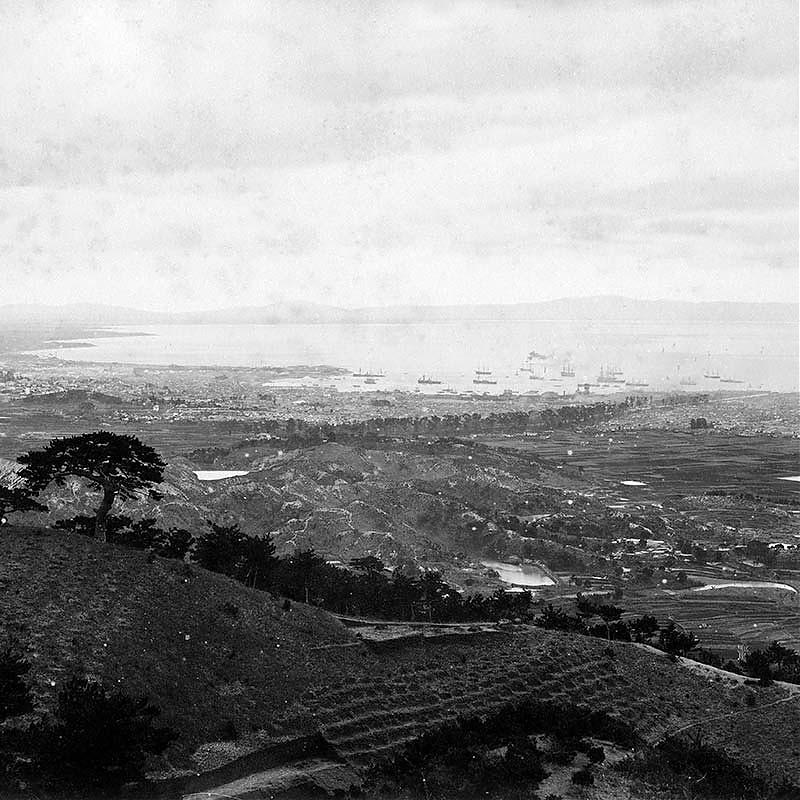
An extremely rare panoramic view of the area around Shitennoji temple in Osaka. The five-storied pagoda of Shitennoji can be seen on the far left. It is interesting to notice how it functioned as an important landmark.
These days Shitennoji temple is virtually invisible because of the surrounding high-rises. Difficult to imagine, but the rural area in the front is now the electronic and pop culture center Den Den Town in Nipponbashi.

The area was a way-station (Shukuba) and was known as Nagamachi (長町) during the Edo Period (1603-1886). It was later renamed Nipponbashi after the nearby bridge over the Dotonbori canal.
During the early 20th century, second-hand bookshops started to establish themselves in the area. After the end of World War II, consumer electronics stores were concentrated here and the area became known as Den Den Town (Electronics Town).
From the late 1990’s, many stores selling manga, anime and figures started to replace the electronics stores, and the area became a pop culture center, similar to Tokyo’s Akihabara.

In view of the height of the photographer’s vantage point, this photo was almost certainly taken from Chobokaku (眺望閣), a five-storied tower in Osaka’s Minami disctrict. The tower was popularly known as Minami no Gokai (南の五階), Gokai meaning “five floors”, and had an observation platform on the top floor that gave a spectacular view of Osaka.
Designed to look like Mt. Fuji, the wooden tower was completed in July 1888 (Meiji 21).
During 1888 (Meiji 21) and 1889 (Meiji 22), Chobokaku was one of the most popular leisure destinations in Osaka. It would help to inspire the construction of a more ambitious tower, Tsutenkaku, in Shinsekai, and made Namba the central attraction of the Minami district.1

After the Chobokaku tower was torn down around 1904 (Meiji 37), the name lived on in the same area as the name of a shopping center called Gokai Hyakaten (五階百貨店, literally “5 storied department store”). In spite of the name, the building only has three floors…

Notes
1 昔の大阪. 大阪の遊び場. Retrieved on 2008-5-16.
Published
Updated
Reader Supported
Old Photos of Japan aims to be your personal museum for Japan's visual heritage and to bring the experiences of everyday life in old Japan to you.
To enhance our understanding of Japanese culture and society I track down, acquire, archive, and research images of everyday life, and give them context.
I share what I have found for free on this site, without ads or selling your data.
Your support helps me to continue doing so, and ensures that this exceptional visual heritage will not be lost and forgotten.
Thank you,
Kjeld Duits
Reference for Citations
Duits, Kjeld (). Osaka 1880s: View on Tennoji, OLD PHOTOS of JAPAN. Retrieved on August 6, 2026 (GMT) from https://www.oldphotosjapan.com/photos/245/view-on-tennoji



There are currently no comments on this article.