
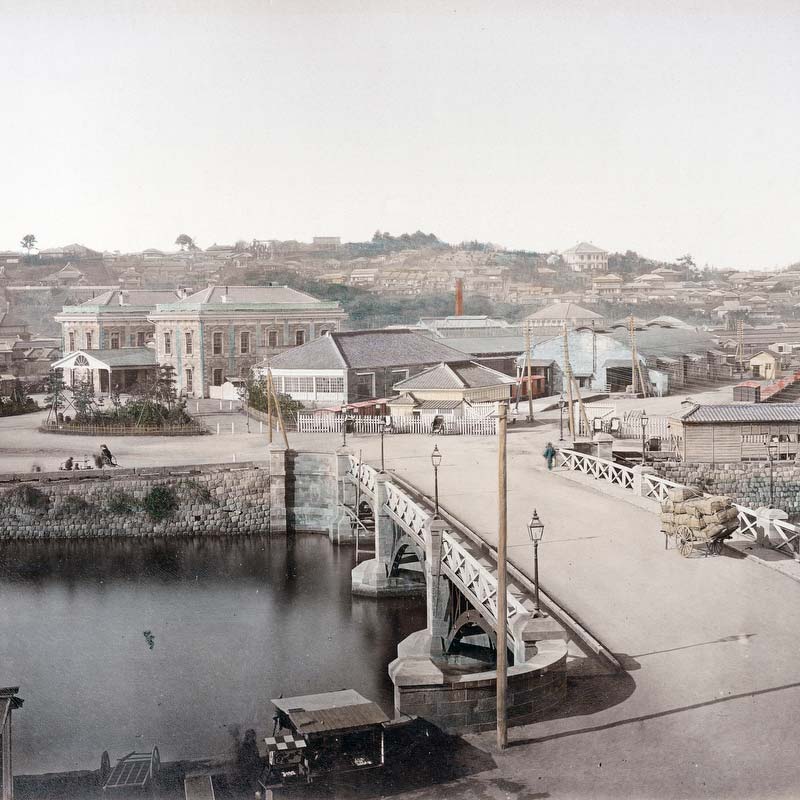
The street leading towards Maedabashi (bridge in front center) is Motomachi, home to many attractive shops. Across the bridge is Hommura Road.
When you walked halfway down this road till Odawara-cho and turned left, it took you through the heart of Yokohama’s Chinatown, generally described in foreign guidebooks of the time as “malodorous.” Kaga-cho, on the top left of this photo, was known for its many warehouses and tea-firing godowns (storehouses).

From Motomachi shopping street a very steep flight of 102 steps lead up the hill and a famous tea shop. This location is where the photographer shot this image. It offered a magnificent view on Yokohama, the harbor and even Mt. Fuji. This area was known locally as the favorite shore resort of Commodore Perry (1794-1858). A teahouse located here in the early days was even supposed to have had a poem written by him.1
Not only Perry had special memories of this place. So did Japanese writer Junichiro Tanizaki (1886-1965) who was enchanted by the shops catering to foreigners in Motomachi2:
Florists, tailors, milliners, bakers, cafes. . . . whatever decorates the windows – flowers, cakes, cloth – is a riot of loud Western color.
Whereas Westerners usually commented on the smells in Chinatown, Tanizaki noticed the smells of Western culture3:
The odor of cigars, the aroma of chocolate, the fragrance of flowers, the scent of perfume – the strongest were the cigars and the chocolate.
Although Motomachi still is a charming shopping district filled with shops that make you repeatedly grab for your wallet, the view has greatly changed. The once fabulous view of the harbor with its majestic ships is now completely blocked by a sea of concrete buildings. Maedabashi, and the canal it crosses, are hidden below a monstrous elevated highway. Perry and Tanizaki would be greatly shocked.

Notes
1 Terry, T. Philip (1920). Terry’s Guide to the Japanese Empire Including Korea and Formosa. Houghton Mifflin Company, 20.
2 Richie, Donald (2002-12-08), Asian Bookshelf: Where West met East, Japan Times.
3 ibid
4 All quotes from Tanizaki, Junichiro (1923). Nikkai (A Lump of Flesh).
Published
Updated
Reader Supported
Old Photos of Japan aims to be your personal museum for Japan's visual heritage and to bring the experiences of everyday life in old Japan to you.
To enhance our understanding of Japanese culture and society I track down, acquire, archive, and research images of everyday life, and give them context.
I share what I have found for free on this site, without ads or selling your data.
Your support helps me to continue doing so, and ensures that this exceptional visual heritage will not be lost and forgotten.
Thank you,
Kjeld Duits
Reference for Citations
Duits, Kjeld (). Yokohama 1900s: View from Motomachi, OLD PHOTOS of JAPAN. Retrieved on August 8, 2026 (GMT) from https://www.oldphotosjapan.com/photos/156/view-from-motomachi

There are currently no comments on this article.