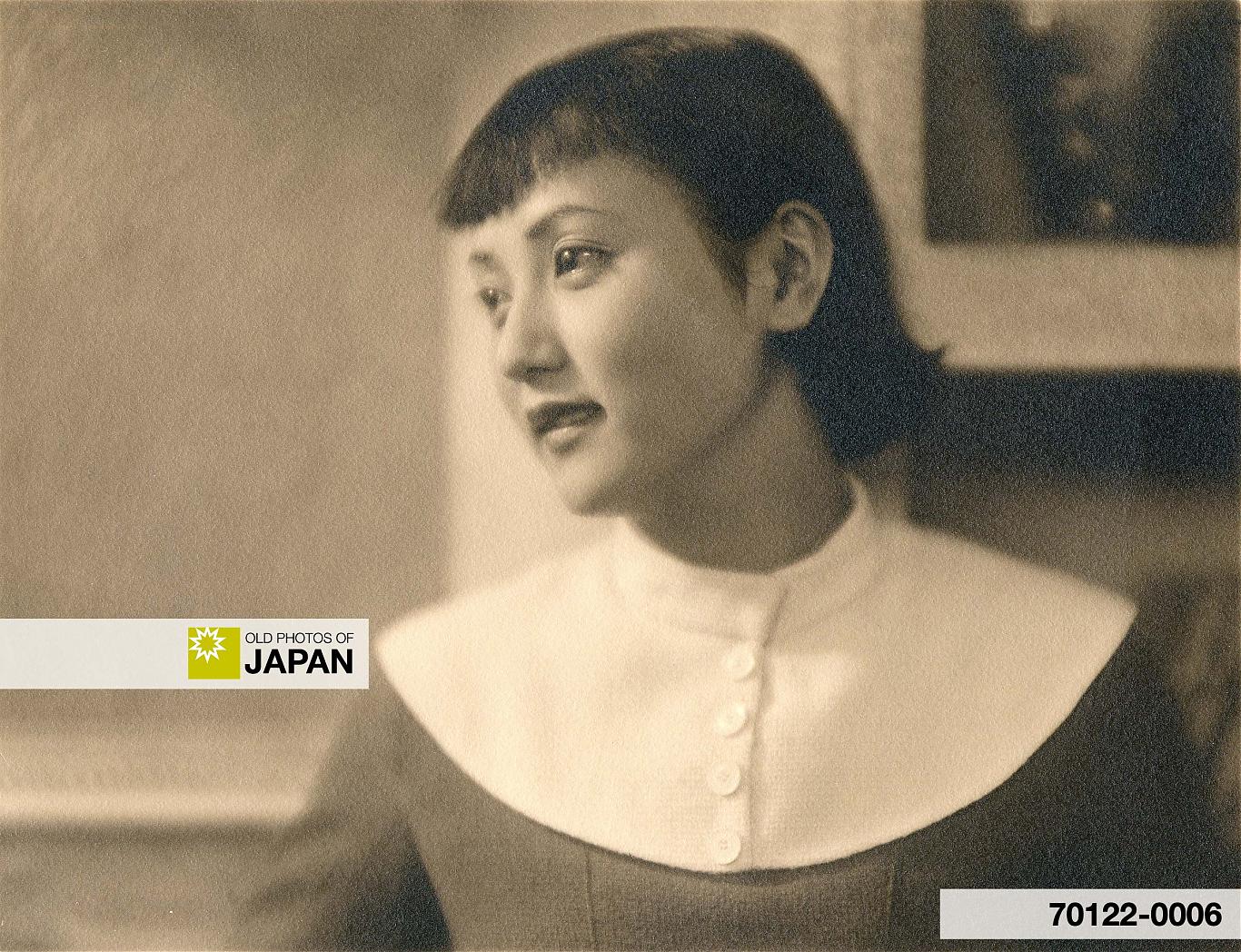
A confident young Japanese woman in modern dress and hairdo during the early Showa Period (1926-1989).
Japanese women first started to experiment with Western fashion during the Meiji Period (1868-1912). By the 1920s, the trendy moga (modern girl) sporting the latest Western fashion and short fashionable hairstyles, had made her entry.
An increasing number of urban young Japanese embraced Western culture wholeheartedly during this period. They dressed in Western styles aspiring to look like Western flappers and listened to Western music, especially jazz. Moga read newly launched magazines which featured articles and fashion tips on the moga lifestyle. To these young people, Japanese culture seemed outdated and from the past.

The term moga, and the male counterpart mobo (modern boy) were loaded with political tension. The moga and mobo were often criticized for the foreign influences they absorbed and displayed.
Social conservatives felt especially threatened by the moga, whose popular image exuded sexual power, westernization and independence.
“In many ways,” writes Kendall H. Brown, a professor of Asian art history at California State University at Long Beach, “women were at the very core of the social and cultural tension in interwar Japan.”1
Both the new roles of women and modernization itself raised difficult questions:
How could one be both Japanese and modern, if modernity is defined as Western? Were modernity and Japaneseness antithetical? Or could individuals and society synthesize some new middle ground? If so, how?
These are questions that may still confound some Japanese today.
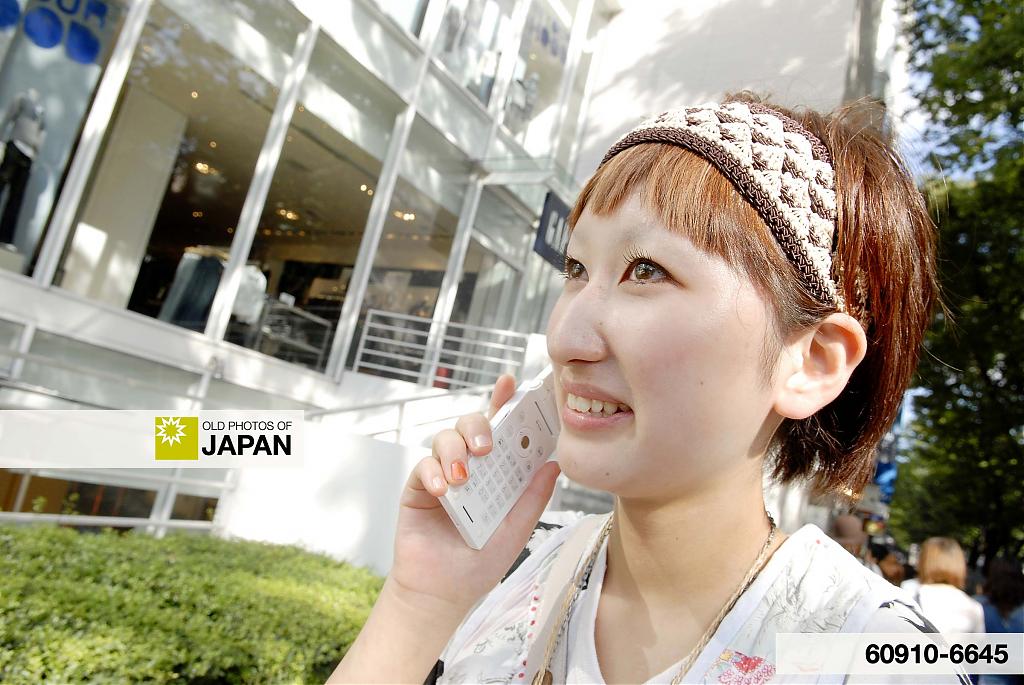
The onset of the Showa Period, with its ultranationalist ideology, spelled the end of moga and mobo, but not the end of Western fashion as can be seen in this image. And certainly not the end of Western influence. It returned with a vengeance after the end of WWII.
In the mid-1990s however, young Japanese in Osaka’s Amerikamura and Tokyo’s Harajuku district started to experiment with fashion in a typical Japanese way.
Many of them reached back to their Japanese roots to come up with fashion ideas. They creatively incorporated typical traditional Japanese clothing items like yukata, haori, hakama, kyahan and geta into their modern looks.

Notes
1 Brown, Kendall H. (2004). The ‘Modern’ Japanese Woman. The Chronicle Review, Volume 50, Issue 37: B19
Published
Updated
Reader Supported
Old Photos of Japan aims to be your personal museum for Japan's visual heritage and to bring the experiences of everyday life in old Japan to you.
To enhance our understanding of Japanese culture and society I track down, acquire, archive, and research images of everyday life, and give them context.
I share what I have found for free on this site, without ads or selling your data.
Your support helps me to continue doing so, and ensures that this exceptional visual heritage will not be lost and forgotten.
Thank you,
Kjeld Duits
Reference for Citations
Duits, Kjeld (). 1930s: Woman with Modern Hairdo, OLD PHOTOS of JAPAN. Retrieved on September 18, 2026 (GMT) from https://www.oldphotosjapan.com/photos/151/woman-with-modern-hairdo


mcvmcv
nice one, kjeld. i like the lady on the right with the cigarette between her lips. would that have been somewhat shocking for the times?
#000013 ·
Kjeld Duits (Author)
Thanks, mcvmcv.
I am not sure if it was shocking. It was common in Meiji Japan for women to smoke pipes, surprising as that may sound. By the Taisho Period that custom was seen as outdated. I haven’t been able to find sources yet about how people thought about women smoking cigarettes and I haven’t interviewed anybody yet about this either. I can imagine it differed according to social class. Images of smoking women, both photographs and other art, are very common in the Taisho period. I also know of several writers of this period who described smoking women. If I am not mistaken, the main persona in Junichiro Tanizaki's novel Naomi also smoked.
#000014 ·
mcvmcv
thanks for your response – just got around to checking this now. that’s interesting you mention Junichiro Tanizaki, i read his short essay “In Praise of Shadows” and found it to be very interesting. perhaps i’ll try to track that book down somewhere…
#000018 ·
Kjeld Duits (Author)
You’re welcome. I love Junichiro Tanizaki. My favorite book is “The Makioka Sisters.” It describes a lot of places in my neighborhood, so that makes it extra interesting.
#000020 ·
Japanese words
Here in Miyako where a lot of the posters in restaurants haven’t been updated, some of these old pictures still exist. Not quite that old, but still going pretty far back.
#000416 ·
Kjeld Duits (Author)
@Japanese words: I have to come and visit!
#000418 ·
Erica Grainger
I really enjoyed reading this article and wonder if I could please have permission to cross-publish it for a non-profit online monthly magazine called, ‘Connect’. It’s a foreign magazine based in Japan and I am the fashion editor for ‘Connect’. I think this article would really help educate people about Japanese culture, fashion and history. Is it possible at all to cross-publish this article? I assure you the author and this website would get full credit and publicity in our magazine. For information about ‘Connect’, please visit this website to view our latest issue: http://ajet.net/2014/11/05/ajet-connect-magazine-november-2014/
Thank you very much for your time
#000569 ·