
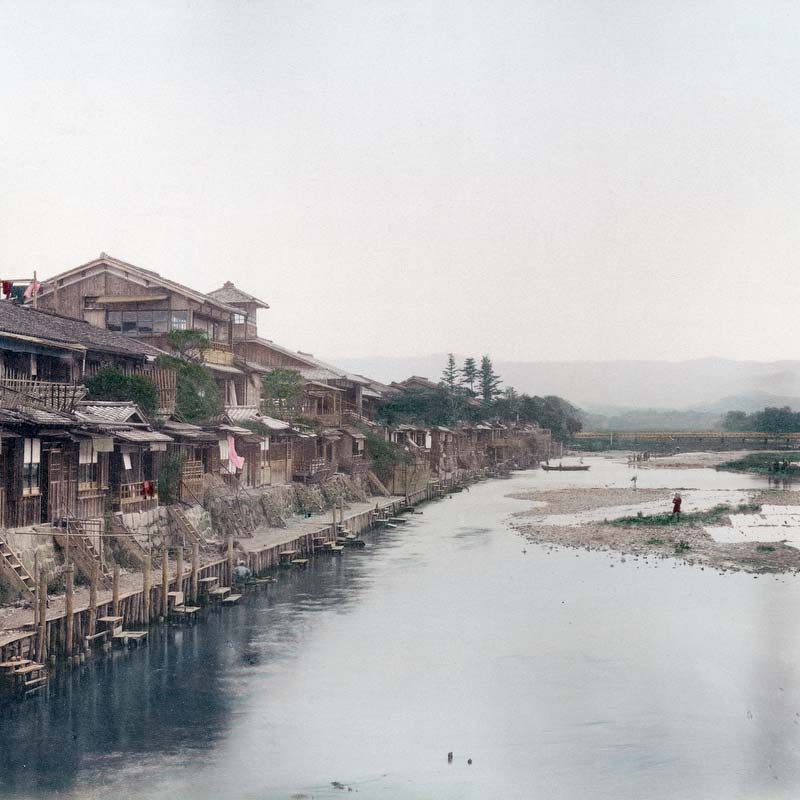
Nagarekawa-dori (流川通り), looking towards the mountains. At the time of this photo, this was an important shopping street in Beppu in Oita Prefecture, which is famous for its thousands of sacred onsen (hot springs).
In the early 20th century, Nagarekawa-dori was regularly featured in novels and artwork. The sister of famous author Sakunosuke Oda (1913-1947) actually opened a cosmetics shop here on 4-chome in 1931 (Showa 6).1
The street was named after a river that used to flow here before it was covered. This river was also known as Nagorikawa (名残川). A stone monument (石柱) referring to Nagorikawa-bashi (Nagorikawa Bridge) can still be found in the area, but the river has faded from most people’s memory.
The history of Beppu reaches far back. As early as the Edo Period (1603-1868), the area boasted eight hot springs and by the end of that period ryokan had already been established along the highway.
Beppu Port was built in 1872 (Meiji 5) and greatly contributed to the growth of the town. Development especially took off around the end of the Meiji Period (1868-1912). Over the years the city would grew into one of Japan’s most famous onsen resorts.
Especially after the end of WII, the city became a popular destination for school excursions and honeymoons.
Beppu has the largest number of hot spring sources in Japan and can claim ten of the eleven types of hot springs that can be found throughout the world. In terms of volume of hot water it is surpassed only by Yellowstone in the USA.
The city offers an amazing array of baths, such as sunayu (sand baths), mushiyu (steam baths) and the world world largest open-air heated mud bath (doroyu). Not surprisingly, the baths play an important role in people’s lives.
Please note that the Google Map shows the location of the street and not the location of the photographer.
Notes
1 Viento ~おおいたの風~ 2003年10月 Vol.1。おおいた文学紀行:別府流川文学。2008年5月1日検索。
Published
Updated
Reader Supported
Old Photos of Japan aims to be your personal museum for Japan's visual heritage and to bring the experiences of everyday life in old Japan to you.
To enhance our understanding of Japanese culture and society I track down, acquire, archive, and research images of everyday life, and give them context.
I share what I have found for free on this site, without ads or selling your data.
Your support helps me to continue doing so, and ensures that this exceptional visual heritage will not be lost and forgotten.
Thank you,
Kjeld Duits
Reference for Citations
Duits, Kjeld (). Beppu 1930s: Nagarekawa-dori, OLD PHOTOS of JAPAN. Retrieved on August 8, 2026 (GMT) from https://www.oldphotosjapan.com/photos/150/beppu


There are currently no comments on this article.