
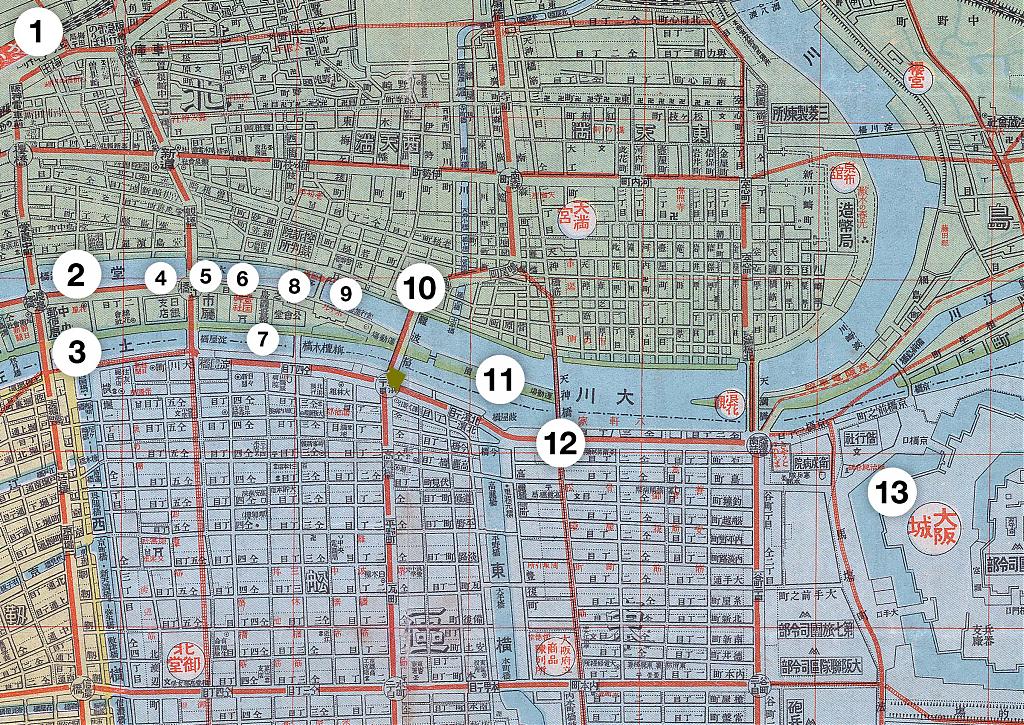
Opened in 1891 (Meiji 24), Nakanoshima Park was Osaka’s very first public park. By the end of the 19th century, the area nearby became the focus of Osaka’s modernization.
It was built on Nakanoshima, a small stretch of land that divides the old Yodo River into the Dojima River and the Tosabori River.
During the Edo Period, the banks of these two rivers were lined with Kurayashiki, the warehouses and residences of samurai who sold goods from their domains in Osaka. But by the end of the 19th century, the area was quickly shedding its Edo face and Nakanoshima became the focus of Osaka’s modernization.
On the side of the island not shown in this photograph, one after the other Western style building rose from the ground.
Osaka’s premier Western hotel, the Jiyutei Hotel opened in Nakanoshima in 1881 (Meiji 14). In 1895 (Meiji 28) it was renamed the Osaka Hotel. It boasted electric light, steam heating as well as English speaking personnel.1
The Neo-Renaissance Osaka branch of the Bank of Japan was built here in 1903 (Meiji 36). The building was designed by Kingo Tatsuno, famous for his design of Tokyo Station.
The Neo-Baroque Prefectural Library was constructed on the island in 1904 (Meiji 37). It was built with a donation from the Sumitomo family.
In 1918 (Taisho 7), the Central Public Hall was completed right behind the library. The funds for this Western building were also donated. By Einosuke Iwamoto (1877-1916), who had made a fortune in the stock market during the Russo-Japanese War (1904-1905). Shortly after he donated the money, he lost his fortune and committed suicide.
Nakanoshima also became the home of Osaka’s brand new City Hall, built between 1918 (Taisho 7) and 1921 (Taisho 10).
This building fever continued for many years, and has recently returned. Development is once again gripping Nakanoshima. A brand new subway connection, the Keihan Nakanoshima line, is opening in 2008 and the area both on and around the island is witnessing a true construction boom. This includes, among others, shopping malls, apartment towers and two skyscrapers which will house the offices of Asahi Shimbun, a concert hall and more.2
Notes
1 Metadata database of Japanese old photographs in Bakumatsu-Meiji Period, Osaka Hotel. Retrieved on 2008-04-07.
2 The Asahi Shimbun. Osaka Nakanoshima New Buildings Project. Retrieved on 2008-04-07.
Published
Updated
Reader Supported
Old Photos of Japan aims to be your personal museum for Japan's visual heritage and to bring the experiences of everyday life in old Japan to you.
To enhance our understanding of Japanese culture and society I track down, acquire, archive, and research images of everyday life, and give them context.
I share what I have found for free on this site, without ads or selling your data.
Your support helps me to continue doing so, and ensures that this exceptional visual heritage will not be lost and forgotten.
Thank you,
Kjeld Duits
Reference for Citations
Duits, Kjeld (). Osaka 1930s: Nakanoshima Park, OLD PHOTOS of JAPAN. Retrieved on October 25, 2026 (GMT) from https://www.oldphotosjapan.com/photos/149/nakanoshima-park

There are currently no comments on this article.